Annunciate vs. Enunciate: Meaning, Difference & Correct Usage
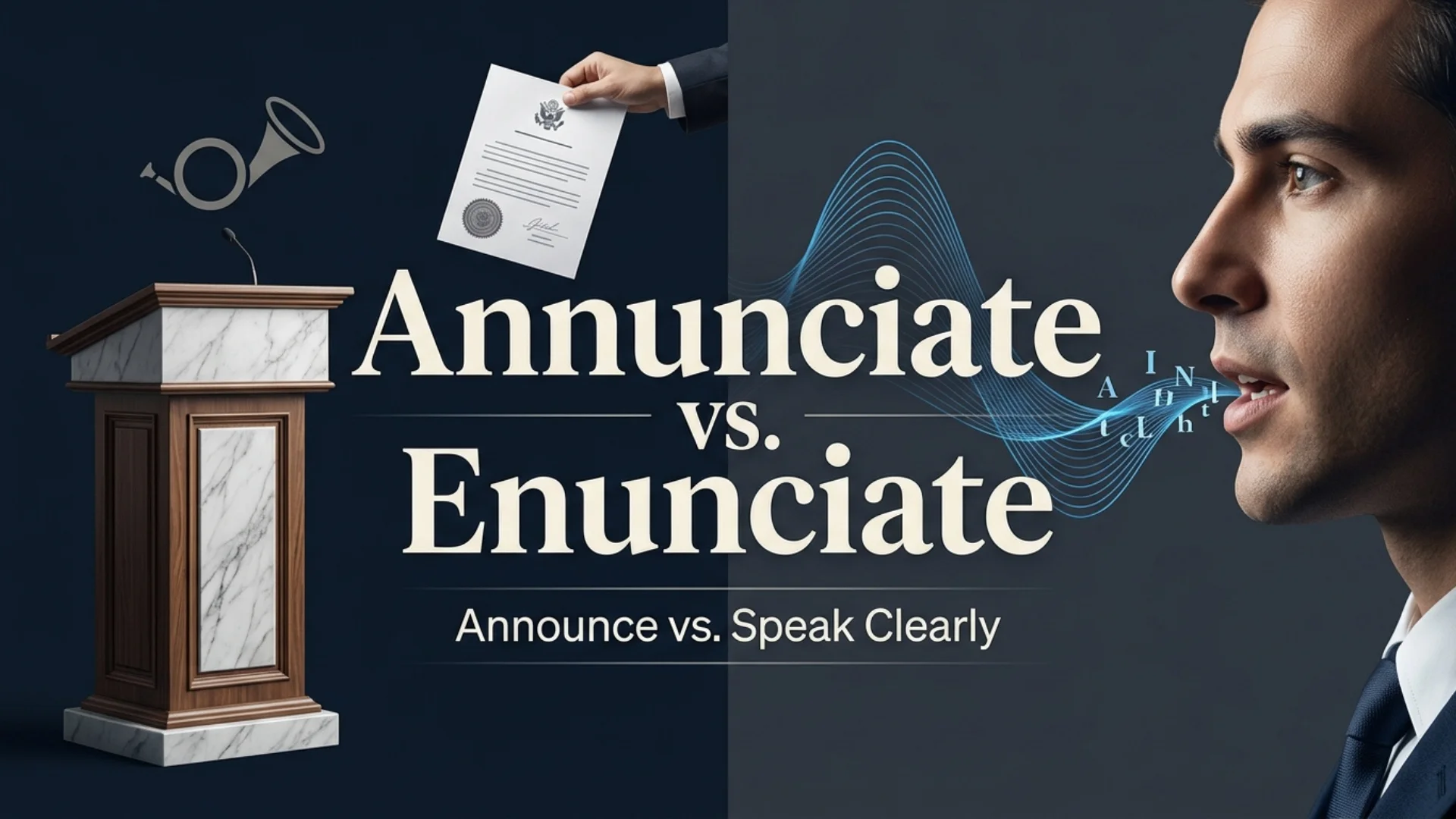
Quick Answer: Annunciate and enunciate are both real words, but they are not interchangeable. Annunciate is a rare verb meaning to announce or proclaim. Enunciate means to pronounce words clearly or, in formal use, to express an idea clearly and precisely. If you mean “speak clearly,” enunciate is the correct choice.
Annunciate vs. Enunciate at a Glance
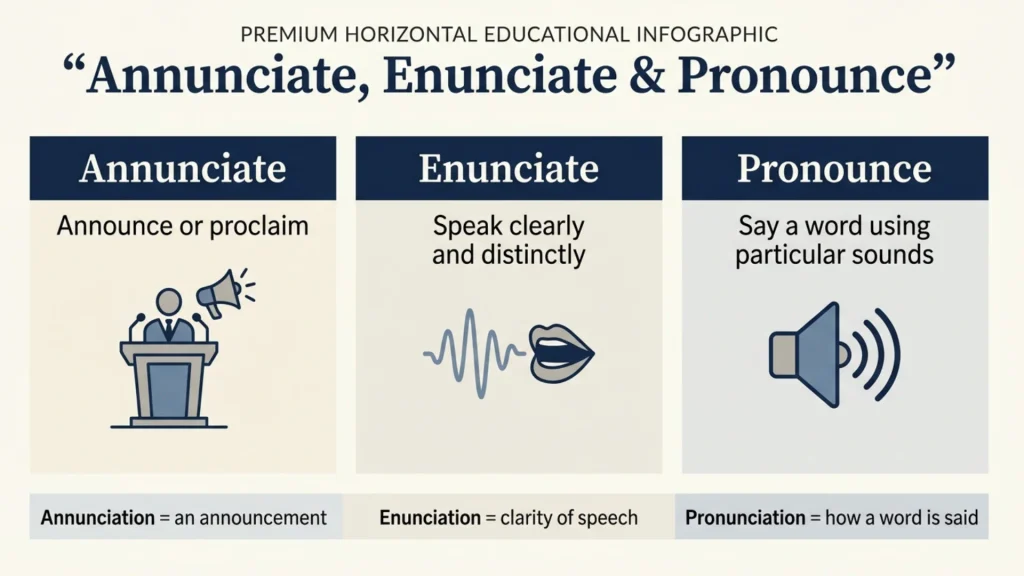
| Word | Main Meaning | Typical Use | Example |
|---|---|---|---|
| Annunciate | To announce or proclaim | Rare, formal, literary | The herald annunciated the news. |
| Enunciate | To pronounce clearly | Speech, teaching, acting, presentations | Please enunciate each word. |
| Enunciate | To state clearly or formally | Ideas, policies, principles | She enunciated the new policy clearly. |
The easiest memory trick is simple:
- Annunciate → announce
- Enunciate → clear speech or clear expression
That distinction resolves most of the confusion around Annunciate vs. Enunciate.
What Does Annunciate Mean?
Annunciate is a real English verb meaning to announce, proclaim, or make something known. It is much less common than announce in modern everyday English, which is why some people assume it is an error.
It is not an error when used with its actual meaning.
For example:
- The messenger annunciated the arrival of the king.
- The official annunciated the decision before the assembled crowd.
- The ceremony formally annunciated the beginning of a new era.
In ordinary modern writing, however, announce will usually sound more natural.
A useful authority check is that Collins English Dictionary defines annunciate as a less common word for announce.
Annunciate in a Sentence
Here are a few natural examples:
- The herald annunciated the birth of the heir.
- The document annunciated a change in policy.
- The speaker rose to annunciate the final result.
The word sounds formal or old-fashioned in many contexts, so it should not be forced into ordinary conversation simply because it resembles enunciate.
What Does Enunciate Mean?
Enunciate commonly means to pronounce words or parts of words clearly and distinctly.
If someone mumbles, rushes, drops syllables, or makes individual sounds difficult to hear, a teacher or speech coach might tell that person to enunciate more clearly.
Examples:
- Please enunciate your words so everyone can understand you.
- The actor enunciated every syllable carefully.
- She slowed down and enunciated the difficult phrase.
- Good speakers do not necessarily speak loudly, but they enunciate clearly.
Enunciate also has a formal meaning: to express or state an idea, principle, or plan clearly.
For example:
- The professor enunciated the central argument of the theory.
- The leader enunciated a clear policy for the coming year.
So enunciation is not limited only to the physical pronunciation of sounds. It can also refer to clearly formulated ideas.
Is It Annunciate or Enunciate?
Use enunciate when you mean:
- speak clearly
- pronounce sounds distinctly
- make words easy to understand
- state an idea clearly
- explain a principle formally
Use annunciate when you mean:
- announce
- proclaim
- make news known
- formally declare something
Compare these sentences:
Correct: Please enunciate your words.
Meaning: Say the words clearly.
Correct but uncommon: The herald annunciated the victory.
Meaning: The herald announced the victory.
Incorrect for clear speech: Please annunciate your words.
That last sentence is the common mistake. If the intended meaning is “pronounce your words clearly,” the verb you want is enunciate.
Enunciation vs. Annunciation
The noun forms cause just as much confusion as the verbs.
Enunciation
Enunciation usually refers to the clear pronunciation or articulation of words. It can also refer to the clear formal expression of an idea or principle.
Examples:
- Her enunciation made the presentation easy to follow.
- The singer’s enunciation was unusually clear.
- The policy lacked a clear enunciation of its goals.
Annunciation
Annunciation means an announcement or proclamation. With a capital A, the Annunciation also refers to the Christian event in which the angel Gabriel announces to Mary that she will conceive and become the mother of Jesus.
So:
- enunciation = clear speaking or clear statement
- annunciation = announcement or proclamation
- the Annunciation = a specific event in Christian tradition
Annunciation vs. Enunciation Example
Consider:
Her enunciation was excellent during the speech.
This means she pronounced her words clearly.
Now compare:
The annunciation of the decision surprised the audience.
This refers to the announcement or proclamation of the decision. In modern everyday English, announcement would usually sound more natural.
Annunciation in Speech: Is That the Right Term?
Usually, no.
If you are describing how clearly someone speaks, the correct term is enunciation, not annunciation.
For example:
Correct: His enunciation improved after several weeks of practice.
Not the intended word: His annunciation improved after several weeks of practice.
People sometimes search for “annunciation speech” or “annunciation meaning speech” because the two words sound similar. In speech training, broadcasting, acting, classroom speaking, and presentations, enunciation is normally the word you need.
Enunciation vs. Pronunciation
Pronunciation and enunciation overlap, but they are not identical.
Pronunciation
Pronunciation is the way a word or sound is said.
It deals with whether the sounds, stress, and syllables of a word are produced according to an accepted pronunciation.
For example, if someone says a word using the wrong vowel sound or puts the stress on the wrong syllable, that is primarily a pronunciation issue.
Enunciation
Enunciation is about clarity and distinctness.
A person can pronounce a word correctly but enunciate it poorly by mumbling or speaking too quickly.
Likewise, a person can enunciate very clearly while still pronouncing a particular word incorrectly.
Simple Example
Imagine someone says a word slowly, loudly, and distinctly, but uses the wrong vowel sound.
Their enunciation may be clear, but their pronunciation is incorrect.
Now imagine someone knows the correct pronunciation but mumbles half the syllables.
Their pronunciation knowledge may be correct, but their enunciation is poor.
Difference Between Enunciation and Pronunciation
| Enunciation | Pronunciation |
|---|---|
| Focuses on clarity | Focuses on how a word is said |
| Concerns distinct sounds and syllables | Concerns accepted sound patterns and stress |
| Can be improved by slowing down and articulating | Often improved by hearing and practicing the correct form |
| “Speak more clearly.” | “Say this word this way.” |
Enunciate vs. Pronounce
The verbs are related, but pronounce is broader.
To pronounce a word is simply to say it using particular sounds. To enunciate is to make those sounds especially clear and distinct.
For example:
- She pronounced the word correctly.
- She enunciated the word slowly so the class could hear every syllable.
You can therefore pronounce something without enunciating it well.
Enunciate vs. Articulate
Enunciate and articulate can overlap, but articulate has a wider range of meanings.
To enunciate often means to make speech sounds clear.
To articulate can mean:
- to express thoughts clearly in words, or
- to pronounce speech sounds clearly.
Compare:
- He enunciated every consonant.
- She articulated her concerns clearly.
The first sentence focuses strongly on speech clarity. The second focuses on expressing an idea successfully.
In normal use, someone described as articulate is often good at expressing ideas, not merely good at pronouncing individual words.
Enunciation vs. Diction
Diction refers more broadly to a person’s choice and manner of words, especially in speaking or writing.
Enunciation is one part of vocal delivery. Diction can involve word choice, clarity, style, register, and how speech is delivered.
A speaker might have:
- clear enunciation
- formal diction
- accurate pronunciation
- strong articulation
These qualities are related, but they are not exact synonyms.
How to Pronounce Annunciate and Enunciate
The words look similar because they share historical roots related to announcing or making something known.
A simple pronunciation guide is:
- annunciate: uh-NUN-see-ate
- enunciate: ih-NUN-see-ate
- annunciation: uh-nun-see-AY-shun
- enunciation: ih-nun-see-AY-shun
The difference at the beginning can be subtle in rapid speech, which helps explain why the words are often confused in writing.
Common Misspellings of Enunciation
Because enunciation contains several similar-looking syllables, spelling mistakes are common.
Common incorrect forms include:
- ennunciation
- enounciation
- ununciation
- enuciation
- enuciate
- announciate
The standard spellings are:
- enunciate
- enunciation
- annunciate
- annunciation
A good memory aid is to connect enunciate with enunciation, and annunciate with announcement.
What Does Correct Enunciation Mean?
Correct or clear enunciation means forming and delivering speech sounds distinctly enough for listeners to understand the words without unnecessary effort.
That does not mean speaking unnaturally slowly or exaggerating every sound.
Good enunciation usually involves:
- finishing words instead of swallowing endings
- making consonants audible
- keeping vowels distinct
- using a reasonable speaking pace
- separating words clearly enough to avoid slurring
- maintaining enough breath support to finish phrases
An accent is not the same thing as poor enunciation. People can speak with any accent and still enunciate clearly.
What Is Over-Enunciation?
Over-enunciation happens when someone exaggerates speech sounds so much that the delivery becomes stiff, artificial, or distracting.
For example, a person may:
- separate every syllable excessively
- overemphasize final consonants
- speak too slowly
- make natural connected speech sound mechanical
Clear speech is the goal. Robotic speech is not.
Good enunciation should improve understanding without making ordinary conversation sound like every syllable is being cross-examined by a committee.
How to Improve Enunciation
Slow Down Slightly
Speaking too quickly can cause sounds and word endings to disappear. You do not need to speak slowly, only slowly enough to complete important syllables.
Finish the Ends of Words
Pay attention to final consonants such as t, d, k, and s. They often carry grammatical or lexical information that listeners need.
Practice Difficult Sound Combinations
Read phrases containing sounds you often blur. Start slowly, then gradually return to a natural pace.
Record Yourself
A short recording can reveal swallowed syllables and rushed sections that you may not notice while speaking.
Read Aloud
Reading a paragraph aloud encourages deliberate phrasing and gives you a controlled way to practice clear speech.
Use Tongue Twisters Carefully
Tongue twisters can help coordination, but speed is not the goal. Practice them slowly and clearly first.
Avoid Excessive Exaggeration
Improving enunciation does not mean turning each word into a theatrical performance. Aim for natural clarity.
Annunciate in a Sentence vs. Enunciate in a Sentence
Here is the contrast in parallel examples:
Annunciate
- The official annunciated the result.
- The herald annunciated the royal decree.
- The messenger annunciated the arrival of the delegation.
In modern English, announced would usually be more natural in all three sentences.
Enunciate
- Please enunciate the last word.
- The actor enunciated each line clearly.
- She learned to enunciate without slowing her speech too much.
- The professor enunciated the principle with precision.
When “Announce” Is Better Than “Annunciate”
Even though annunciate is a valid word, it is uncommon enough that it may distract readers.
Compare:
The company annunciated its new product.
The company announced its new product.
Both can convey the idea of making something known, but the second sounds far more natural in contemporary everyday English.
So the practical rule is:
- use announce for ordinary announcements
- recognize annunciate as a legitimate but uncommon alternative
- use enunciate when talking about clear speech or clearly stated ideas
What Does Annunciation Mean for Catholics?
In Catholic usage, the Annunciation refers to the event in which the angel Gabriel announces to the Virgin Mary that she will conceive Jesus.
The Solemnity of the Annunciation of the Lord is normally associated with March 25, nine months before Christmas, although the liturgical observance can be transferred in some years when it conflicts with higher-ranking days in Holy Week or the Easter period.
This religious meaning is distinct from enunciation, which concerns clear speech or expression.
Why People Confuse Annunciate and Enunciate
The confusion is understandable for three reasons.
First, the spellings are very similar.
Second, both words have histories involving the idea of making something known.
Third, enunciate itself can mean both “pronounce clearly” and “state clearly or formally,” creating some semantic overlap with announcing or declaring.
That is why the oversimplified claim that “annunciate is not a word” is inaccurate. The real distinction is about meaning and modern usage, not whether one spelling exists.
A Simple Memory Trick
Remember these two associations:
ANNunciate → ANNounce
ENunciate → ENunciation → clear speech
If the sentence is about making news known, think announce/annunciate.
If the sentence is about speaking clearly, think enunciate.
More Grammar Comparisons
If you enjoy side-by-side usage guides, you may also find these helpful:
Frequently Asked Questions
What does annunciate mean?
Annunciate means to announce, proclaim, or make something known. It is a real but uncommon verb, and announce is usually more natural in everyday English.
What does annunciating mean?
Annunciating is the present participle of annunciate. It means announcing or proclaiming something.
Is it pronounce or enunciate?
Use pronounce when talking about how a word is said. Use enunciate when emphasizing how clearly and distinctly someone says the sounds or words.
Is it enunciation or annunciation?
Use enunciation for clear pronunciation or clear formal expression. Use annunciation for an announcement or proclamation. With a capital A, the Annunciation refers to the Christian event involving Gabriel and Mary.
Is it annunciate or enunciate?
If you mean speak or pronounce clearly, use enunciate. If you mean announce or proclaim, annunciate is possible, although announce is much more common.
How is annunciation pronounced?
A simple guide is uh-nun-see-AY-shun. The main stress falls on the “AY” syllable.
What is the correct annunciation?
If you mean “the correct way to say a word,” you probably mean correct pronunciation or clear enunciation, not annunciation. Annunciation usually refers to an announcement or, with a capital A, the Christian event.
What does Annunciation mean for Catholics?
For Catholics, the Annunciation is the event in which the angel Gabriel announces to Mary that she will conceive Jesus. The solemnity is normally observed on March 25.
Can you give me an example of pronunciation and enunciation?
Yes. Suppose someone says a word using all the correct sounds but mumbles it. Their pronunciation may be correct, but their enunciation is poor. If they say the same word clearly and distinctly, their enunciation has improved.
Final Answer
The difference between Annunciate vs. Enunciate comes down to purpose. Annunciate means to announce or proclaim and is uncommon in modern everyday English. Enunciate means to pronounce words clearly or to state an idea clearly and formally.
For ordinary speech advice, “enunciate your words” is correct. For making news known, “announce” is usually more natural than annunciate. And when comparing annunciation vs. enunciation, remember that annunciation concerns an announcement, while enunciation concerns clarity of speech or expression.