Combating vs Combatting: Which Spelling Is Correct?
Quick Answer: Both combating and combatting are correct spellings of the -ing form of combat.
The main difference is usage preference:
- Combating with one t is the safer and more common choice in American English and much international writing.
- Combatting with two t’s is also a recognized spelling and appears particularly in British and Commonwealth English.
- Both words have exactly the same meaning.
- Neither spelling changes pronunciation or grammatical function.
- For most U.S. professional, academic, journalistic, and business writing, combating is the best default.
Examples:
The city is combating air pollution. ✅
The city is combatting air pollution. ✅
Both sentences mean the same thing.
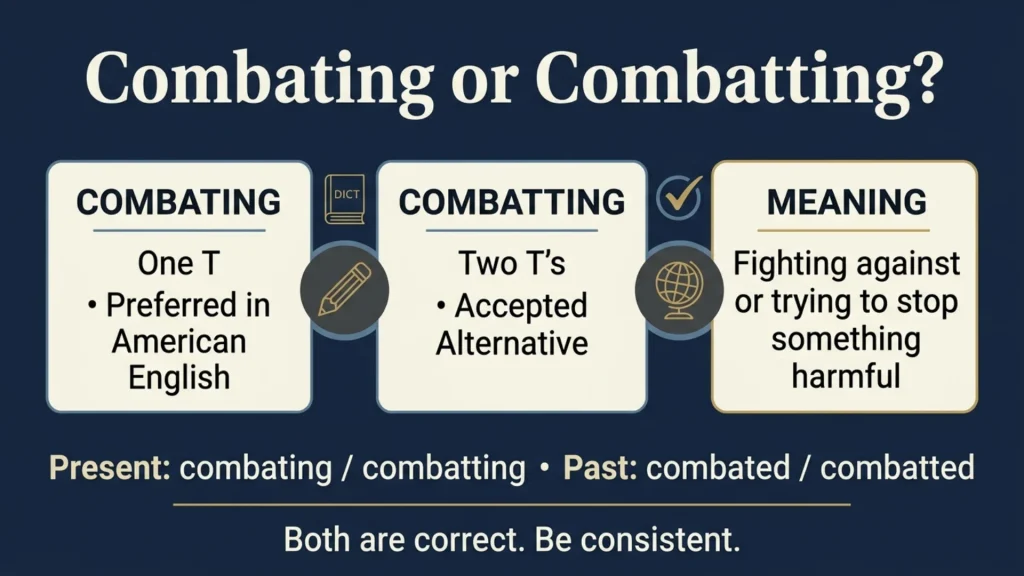
Combating vs Combatting at a Glance
| Feature | Combating | Combatting |
|---|---|---|
| Correct spelling | Yes | Yes |
| Number of t’s | One | Two |
| Meaning | Fighting against | Fighting against |
| American English | Preferred | Accepted but less common |
| British English | Common and accepted | Also accepted |
| Present participle | Yes | Yes |
| Gerund | Yes | Yes |
| Pronunciation | Same meaning and function | Same meaning and function |
| Past-tense partner | combated | combatted |
| Best default for U.S. writing | Yes | Usually no |
The most important point is simple:
Combatting is not automatically a spelling mistake.
Major dictionaries recognize both forms.
Which Is Correct: Combating or Combatting?
Both are correct.
The verb combat can form its present participle in two recognized ways:
combat → combating
and:
combat → combatting
Cambridge Dictionary explicitly identifies -tt- or -t- as accepted inflection patterns for the verb combat. You can see the Cambridge Dictionary entry for combat.
So the choice is not really:
correct vs. incorrect
It is closer to:
more common spelling vs. accepted alternative spelling
For American English, combating is normally the safest choice.
What Does Combating Mean?
Combating means:
fighting against, opposing, resisting, or taking action to stop or reduce something harmful or unwanted.
Examples:
- combating crime
- combating poverty
- combating disease
- combating misinformation
- combating climate change
- combating fraud
- combating inflation
- combating discrimination
- combating corruption
- combating cybercrime
Example sentence:
The organization is combating food insecurity in rural communities.
Here, no literal physical fight is happening.
The word means actively working against a problem.
What Does Combatting Mean?
Combatting means exactly the same thing as combating.
It is simply the alternative spelling with a doubled t.
Example:
The government is combatting tax fraud.
means the same as:
The government is combating tax fraud.
There is no difference in:
- definition
- tense
- grammatical role
- level of seriousness
- basic pronunciation
- type of action
The extra t changes spelling preference, not meaning.
Does Combating Have One or Two T’s?
The spelling combating has one t at the end of the base word before -ing:
combat + ing = combating
The alternative spelling:
combatting
has two consecutive t’s:
combat + t + ing = combatting
Both are recognized.
So if someone asks whether the word has one or two t’s, the precise answer is:
Both spellings exist, but “combating” with one t is the more common default in American English.
Why Are There Two Spellings?
The variation comes from English rules for doubling a final consonant before suffixes such as:
- -ing
- -ed
Compare:
run → running
begin → beginning
but:
open → opening
visit → visiting
English usually doubles a final consonant when particular stress and spelling conditions are met.
The verb combat is unusual because pronunciation and spelling conventions have developed differently across varieties of English.
As a result, both forms became established:
combating
and:
combatting
This is why simply applying one mechanical spelling rule and declaring the other form wrong does not accurately describe current English usage.
Combating in American English
In American English, combating is normally preferred.
Examples:
Researchers are combating antibiotic resistance.
The agency introduced measures for combating fraud.
Schools are combating chronic absenteeism.
Technology can help in combating online scams.
If you are writing for:
- a U.S. audience
- an American company
- a U.S. publication
- a university assignment using American English
- general international web content
combating is usually the safest spelling.
Combatting in British English
Combatting is a recognized spelling in British English.
Examples:
The programme focuses on combatting antisocial behaviour.
Authorities are combatting financial crime.
However, it is important not to oversimplify this into:
British = combatting only
British dictionaries also recognize combating.
So British writers may encounter both forms.
If a publisher or organization has its own style guide, follow that guide consistently.
Is Combating or Combatting Correct in AP Style?
For AP-style American writing, use:
combating
with one t.
Example:
Officials are combating the spread of misinformation.
The single-t spelling aligns with the standard American preference used in journalistic and professional copy.
If you work for an organization with a current AP Stylebook subscription or an internal newsroom style sheet, its house guidance should always take priority.
Combating vs Combatting in Formal Writing
Both are legitimate English spellings, but combating is the better default for most formal writing aimed at an international or American audience.
Use:
The report outlines strategies for combating unemployment.
rather than switching randomly between:
combating
and:
combatting
Consistency matters more than trying to display every spelling variant in the same document.
Combating vs Combatting in Academic Writing
Academic writers should normally follow:
- the required variety of English,
- the institution’s style guide,
- the journal’s house style.
For an American academic paper:
combating
is the straightforward default.
A British journal may permit either spelling or prefer one according to its house style.
Do not change spelling halfway through a paper.
Combating vs Combatting in Business Writing
For most business documents, use combating unless your organization’s style guide prefers the doubled form.
Examples:
Our fraud team is combating suspicious transactions.
The company has introduced measures for combating workplace harassment.
New controls are aimed at combating data theft.
The word is common when discussing risks, threats, or harmful trends.
Combating vs Combatting in News Writing
News stories frequently use combat figuratively.
Common combinations include:
- combating crime
- combating inflation
- combating terrorism
- combating misinformation
- combating disease
- combating corruption
- combating poverty
For U.S.-style journalism, combating is the natural default.
Combating vs Combatting in UK Writing
British English allows more spelling variation here than many simple grammar guides suggest.
You may encounter:
combating
or:
combatting
in professionally edited UK material.
That makes consistency more useful than treating the pair as if one must always be wrong.
If you are writing for a particular British publication, check its house style.
Combatting or Combating: Does the Meaning Change?
No.
Compare:
Scientists are combating the disease.
Scientists are combatting the disease.
Both mean that scientists are taking action against the disease.
The spelling variation does not create two separate definitions.
Combating as a Present Participle
Combating can function as the present participle of combat.
Example:
The team is combating fraud.
Structure:
is + combating
This creates a continuous verb form.
More examples:
Police are combating organized crime.
Researchers are combating the outbreak.
The company is combating counterfeit sales.
Combatting as a Present Participle
The double-t spelling performs exactly the same grammatical function.
Example:
The team is combatting fraud.
The grammar has not changed.
Only the spelling variant has.
Combating as a Gerund
The -ing form can also behave more like a noun.
Example:
Combating corruption requires long-term reform.
Here, combating corruption functions as the subject of the sentence.
Another example:
Combating misinformation remains difficult.
You can also encounter the double-t spelling:
Combatting misinformation remains difficult.
Again, both are grammatically possible.
Combat vs Combating
Combat is the base verb.
Combating is its -ing form.
Compare:
We must combat fraud.
and:
We are combating fraud.
The first uses the base form after must.
The second uses the present participle after are.
Combat vs Combatting
The same rule applies with the alternative spelling:
They combat discrimination.
They are combatting discrimination.
The doubled spelling does not make it a different verb.
Combated vs Combatted
The same spelling variation appears in the past tense.
Both forms exist:
combated
and:
combatted
Examples:
The city combated the outbreak successfully.
The city combatted the outbreak successfully.
For American English, combated is generally the safer default.
The variants pair naturally:
| -ing Form | Past Form |
|---|---|
| combating | combated |
| combatting | combatted |
Consistency is useful.
If you choose combating, using combated elsewhere in the same document usually creates the cleanest style.
Is Combated a Word?
Yes.
Combated is a correct past-tense and past-participle form of combat.
Example:
The organization successfully combated the spread of false information.
It is not necessary to double the t.
Is Combatted Also Correct?
Yes.
Combatted is also recognized as an alternative past form.
It is less likely to be the default in American English but appears in edited English, especially where the writer also uses combatting.
Why Doesn’t Combating Always Double the T?
English consonant doubling is partly influenced by syllable stress.
Compare:
begin → beginning
because the final syllable is stressed.
But:
visit → visiting
because the final syllable is not stressed.
With combat, pronunciation patterns and regional convention complicate the situation, and established dictionaries recognize both doubled and undoubled inflections.
Therefore, the dictionary evidence matters more than trying to force the word into one oversimplified rule.
Words Related to Combat
Understanding the word family makes the spelling clearer.
| Word | Part of Speech | Meaning |
|---|---|---|
| combat | noun | fighting or conflict |
| combat | verb | fight against or oppose |
| combating | verb form / gerund | fighting against |
| combatting | variant verb form / gerund | fighting against |
| combated | past verb form | fought against |
| combatted | variant past form | fought against |
| combatant | noun | person engaged in fighting |
| combative | adjective | eager or ready to fight or argue |
| combatively | adverb | in a combative manner |
Notice that words such as combatant and combative do not create the same one-t/two-t spelling choice.
What Does Combat Mean as a Verb?
As a verb, combat means to fight against or try to stop something harmful.
Examples:
to combat poverty
to combat crime
to combat disease
to combat discrimination
to combat fraud
The “fight” can be literal or figurative.
You do not need soldiers, weapons, or an actual battlefield for something to be described as combating a problem.
What Does Combat Mean as a Noun?
As a noun, combat refers to fighting or conflict.
Example:
The soldiers were trained for combat.
Another:
The two characters engage in hand-to-hand combat.
The noun and verb share spelling but perform different grammatical jobs.
Combating in a Sentence
Here are natural examples using the preferred American spelling:
- The government is combating inflation.
- Researchers are combating infectious diseases.
- The charity works on combating homelessness.
- New software helps companies combatting? No: companies combat or are combating cybercrime.
- Schools are combating bullying.
- Regulators are combating financial fraud.
- The campaign focuses on combating misinformation.
- Doctors are combating antibiotic resistance.
- Communities are combating food insecurity.
- The company is combating counterfeit products.
Combatting in a Sentence
Examples using the accepted double-t variant:
- The agency is combatting corruption.
- The programme focuses on combatting poverty.
- Researchers are combatting the spread of disease.
- The government introduced measures for combatting fraud.
- Local groups are combatting antisocial behaviour.
These sentences are grammatically sound.
Common Phrases With Combating
Certain combinations appear frequently because combat naturally describes an active response to a harmful condition.
Combating Climate Change
Taking action to reduce or respond to climate-related problems.
Combating Crime
Working to reduce or prevent criminal activity.
Combating Poverty
Working against poverty and its causes.
Combating Disease
Trying to control or prevent disease.
Combating Misinformation
Trying to reduce false or misleading information.
Combating Corruption
Taking action against corrupt practices.
Combating Fraud
Preventing, detecting, or reducing fraudulent activity.
Is “Combatting Against” Correct?
Usually, combat does not need against.
Natural:
We are combating corruption.
Less concise:
We are combating against corruption.
Because combat already contains the idea of fighting against something, adding against is often unnecessary.
Similarly:
The policy combats fraud.
is cleaner than:
The policy combats against fraud.
Is “Combating With” Correct?
It depends on the meaning.
The organization is combating poverty with education programs.
Here, with introduces the method.
That is natural.
But:
combating with poverty
would usually be awkward if you mean fighting poverty.
Use:
combating poverty
instead.
Combatting vs Fighting
Fighting is broader and often more conversational.
Combating can sound slightly more formal and is particularly common for:
- social problems
- diseases
- crime
- inflation
- fraud
- pollution
- misinformation
Compare:
The country is fighting inflation.
The country is combating inflation.
Both are natural.
The second sounds somewhat more formal or institutional.
Combatting vs Battling
Battling often feels more vivid or dramatic.
Example:
Doctors are battling the outbreak.
Doctors are combating the outbreak.
Both can work, but combating is often more neutral in reports and formal writing.
Combatting vs Countering
Countering emphasizes taking action that opposes or neutralizes something.
Example:
The company is countering misinformation.
This may be preferable when the response specifically involves answering or neutralizing a claim.
Combatting vs Preventing
These words are not exact synonyms.
Preventing means stopping something from happening.
Combating can include action against a problem that already exists.
Compare:
The vaccine helps prevent infection.
Doctors are combating an existing outbreak.
Choose the verb that matches the actual action.
Combatting vs Tackling
Tackling often means dealing directly with a difficult problem.
Example:
The city is tackling homelessness.
This can sound less aggressive than:
The city is combating homelessness.
For social problems involving people, wording matters. Sometimes addressing or tackling is more precise than language that metaphorically frames the issue as an enemy.
What Is Another Word for Combatting?
Depending on context, alternatives include:
- fighting
- opposing
- resisting
- countering
- battling
- tackling
- confronting
- addressing
- challenging
- curbing
- reducing
- preventing
- suppressing
- controlling
- stopping
- limiting
- resisting
The best synonym depends on what is actually happening.
For another word-choice distinction where similar forms perform different roles, see GrammarRead’s Respond vs. Response.
Which Synonym Should You Use?
Fighting
Best for general opposition.
Countering
Best when responding to or neutralizing something.
Preventing
Best when stopping something before it happens.
Addressing
Best when dealing with a problem without implying a literal fight.
Tackling
Best for actively dealing with a difficult issue.
Resisting
Best when refusing to yield to a force or influence.
Curbing
Best when reducing something rather than eliminating it entirely.
Combatant Meaning
A combatant is someone who takes part in fighting or combat.
The word is especially common in military and legal contexts.
Example:
The agreement distinguished combatants from civilians.
Notice the spelling:
combatant
not:
combattant
The one-t/two-t variation of combating/combatting does not automatically spread to every word in the combat family.
What Is a Person Who Fights in a War Called?
Common terms include:
soldier
or, more broadly:
combatant
A combatant is a person actively engaged in fighting.
The exact term depends on context because not every combatant is necessarily a conventional soldier.
What Do You Call Someone Who Refuses to Fight in War?
A person who refuses military service because of moral, ethical, or religious beliefs may be called a:
conscientious objector
That term has a specific meaning and should not be used simply for anyone who avoids a fight.
What Is a Fancy Word for Fighting?
Depending on context:
- combat
- conflict
- confrontation
- hostilities
- struggle
- engagement
- clash
- contest
These words are not perfect substitutes in every sentence.
For example, hostilities is commonly used for armed conflict, while confrontation can refer to nonmilitary disputes.
What Is a Slang Term for a Fighter?
Slang and informal terms depend heavily on context.
Possible examples include:
- scrapper
- bruiser
- brawler
These generally suggest someone who physically fights and should not replace formal terms such as soldier or combatant in serious contexts.
Combative Meaning
Combative is an adjective meaning inclined or ready to fight, argue, or challenge.
Example:
His tone became increasingly combative.
It does not have the spelling:
combattive
The standard form is:
combative
Combativeness Meaning
Combativeness is the noun form referring to a tendency to fight or argue.
Example:
Her combativeness made negotiation difficult.
Again, there is no extra t after combat in the standard word.
Combatively Meaning
Combatively is the adverb.
Example:
He responded combatively to the criticism.
The word describes the manner in which someone responds.
Combatting or Combating: One T or Two T’s?
Use this practical rule:
For American English
Choose:
combating
For British English
Both are recognized, though combatting is an established alternative.
For International Web Content
Choose:
combating
unless your house style specifies otherwise.
For a Quotation or Official Name
Preserve the original spelling.
Within One Document
Pick one spelling and stay consistent.
Is Combatting a Misspelling?
No.
Combatting is recognized by major dictionaries as an accepted form of the verb combat.
Calling it universally incorrect is too strong.
It may be less common or not preferred by a particular style guide, but that is different from being a nonexistent word.
Is Combating a Misspelling?
No.
Combating is a fully standard form and is particularly common in American English.
If you are uncertain which spelling your audience expects, combating is usually the safer default.
Is It Combatting Crime or Combating Crime?
Both are grammatically correct:
combating crime
combatting crime
For American writing, prefer:
combating crime
Example:
The city introduced new measures aimed at combating crime.
Combating Climate Change or Combatting Climate Change?
Both spellings are possible.
For a U.S. or international general audience, use:
combating climate change
The spelling choice does not alter the meaning.
Combating Corruption or Combatting Corruption?
Again, both are recognized.
Recommended U.S. form:
combating corruption
Example:
Transparency is essential for combating corruption.
Combating Misinformation or Combatting Misinformation?
Both are possible, but:
combating misinformation
is the stronger default for American English.
Depending on context, alternatives such as countering misinformation or addressing misinformation may also be more precise.
Related Spelling Pattern: Double Consonants Before -ing
A useful general rule is:
When a one-syllable verb ends in a single vowel followed by a single consonant, English commonly doubles that consonant before -ing.
Examples:
run → running
sit → sitting
stop → stopping
With longer words, stress often matters:
begin → beginning
but:
visit → visiting
English then supplies enough historical and regional variation to make sure the rule cannot simply enjoy a peaceful retirement.
For another spelling pair involving competing forms, see Linchpin vs. Lynchpin.
Why Consistency Matters
If you use:
combating
in one paragraph and:
combatting
in the next for no reason, readers may assume one is a typo.
Both may be correct individually, but random switching looks careless.
Choose according to:
- audience
- region
- style guide
- dictionary
- publication policy
Then remain consistent.
This same principle applies to many variant spelling choices. GrammarRead’s Hassle vs. Hastle covers another pair where understanding the accepted spelling is more useful than trusting what merely looks plausible.
Frequently Asked Questions
Which is correct, combatting or combating?
Both are correct. Combating is the more common and safer choice in American English, while combatting is also a recognized variant and appears particularly in British and Commonwealth usage.
Does combating have one or two t’s?
Combating has one t before -ing. The accepted variant combatting has two.
Is “combating” or “combatting” correct in AP style?
For AP-style American copy, use combating with one t. If you work under a current newsroom or organization’s internal AP-based style sheet, follow its specific guidance.
What does “combatting” mean?
Combatting means fighting against, opposing, or trying to stop or reduce something harmful or unwanted. It has the same meaning as combating.
What is another word for “combatting”?
Possible alternatives include fighting, opposing, resisting, countering, tackling, confronting, addressing, curbing, and battling. The best synonym depends on context.
What is a person who fights in a war called?
A soldier is the everyday answer in many contexts. Combatant is a broader term for someone actively engaged in fighting.
What do you call someone who refuses to fight in war?
Someone who refuses military service because of sincere moral, ethical, or religious objections may be called a conscientious objector.
What’s a fancy word for fighting?
Depending on context, you can use combat, conflict, confrontation, hostilities, struggle, engagement, or clash.
What is a slang term for a fighter?
Informal terms include scrapper, bruiser, and brawler, although their tone and exact meaning differ.
Is combatting correct in British English?
Yes. Combatting is an accepted spelling in British English, although combating is also used.
What is the past tense of combat?
Both combated and combatted are recognized. Combated is generally the safer choice in American English.
Is “combatted” a word?
Yes. Combatted is an accepted alternative past-tense and past-participle form of combat.
How do you spell combating in American English?
The normal American spelling is:
combating
with one t before -ing.
Final Answer
The Combating vs Combatting question does not have a one-correct, one-wrong answer.
Both spellings are recognized:
combating ✅
combatting ✅
Both mean:
fighting against, opposing, or trying to stop something harmful.
The practical difference is preference.
For American English and most international professional content, combating is the safest default.
Combatting remains a legitimate alternative, particularly in British and Commonwealth usage.
The same variation appears in the past forms:
combated
and:
combatted
Whichever form you use, consistency is the important part.