Violet vs Indigo vs Purple: What’s the Real Difference?
Violet vs Indigo vs Purple can be confusing because all three sit in the blue-to-red area of human color perception and are often used interchangeably in everyday language. Scientifically and visually, however, they are not the same thing.
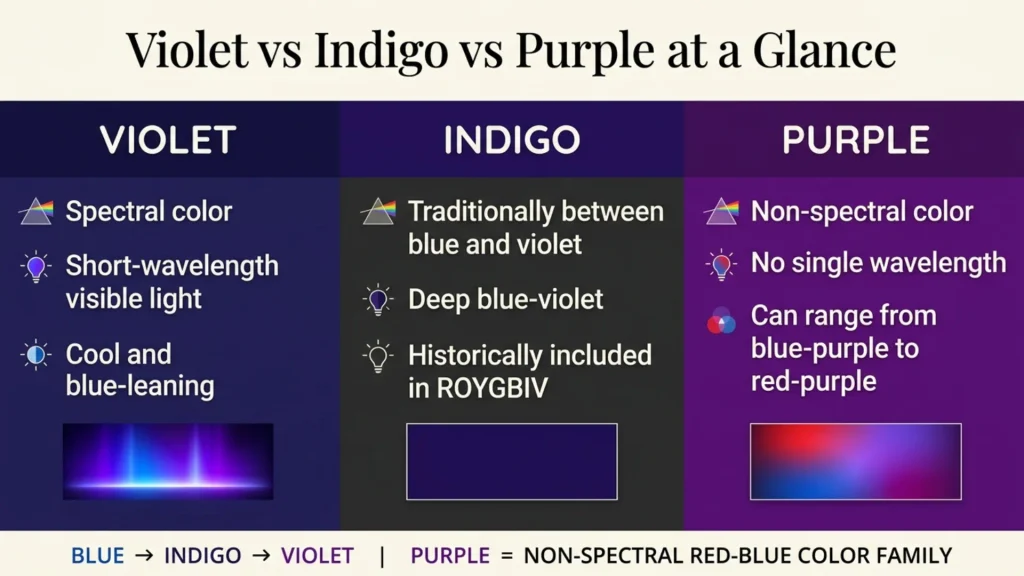
The simplest distinction is this: violet is a spectral color at the short-wavelength end of visible light, indigo is traditionally placed between blue and violet, and purple is a non-spectral color created by our visual system when it receives a combination of red and blue or violet-like stimulation.
That does not mean purple is “fake.” It means there is no single wavelength of visible light that corresponds to purple in the way there is for spectral violet.
Quick Answer: Violet vs Indigo vs Purple
| Feature | Violet | Indigo | Purple |
|---|---|---|---|
| Basic appearance | Bright blue-violet | Deep blue-violet | Red-blue family |
| Spectral color? | Yes | Historically treated as one | No |
| Position | Short-wavelength end of visible spectrum | Between blue and violet traditionally | Not a single position in the spectrum |
| Usually leans toward | Blue | Deep blue | Red or blue depending on shade |
| Typical impression | Cool, vivid | Dark, rich | Broad range from warm to cool |
| Common confusion | Purple | Navy or violet | Violet |
| Digital named-color example | Violet | Indigo | Purple |
A useful visual shortcut:
- Violet = brighter and more blue-leaning
- Indigo = darker and closer to deep blue
- Purple = broader red-and-blue color family
These boundaries are not mathematical walls. Human color naming is messier than paint companies and rainbow diagrams would have us believe.
What Is Violet?
Violet is a color found at the short-wavelength end of the visible spectrum, next to ultraviolet.
When white light passes through a prism, shorter visible wavelengths are perceived toward the violet end.
The Physics Classroom’s visible-spectrum explanation explains how visible light separates into different wavelength regions and places violet at the short-wavelength end.
Violet usually appears:
- cool
- blue-leaning
- brighter than typical indigo
- less red than many purples
A crucial point is that the word violet can be used in more than one way. In physics, spectral violet refers to short-wavelength visible light. In paints, screens, fashion, and everyday speech, “violet” may simply describe a violet-looking color rather than pure monochromatic spectral light.
Also check: Emasculate vs. Demasculate
What Is Indigo?
Indigo is traditionally placed between blue and violet in the familiar rainbow sequence:
Red, Orange, Yellow, Green, Blue, Indigo, Violet
It generally looks like a very deep blue with a violet cast.
Unlike violet, however, indigo has fuzzy boundaries. Modern color science does not require seven rigid rainbow bands, because the visible spectrum is continuous rather than divided into seven physical stripes.
That is why one diagram may show a distinct indigo band while another may simply transition from blue into violet.
What Does Indigo Look Like?
Think of:
- a very deep blue
- blue with a subtle violet undertone
- traditional indigo dye
- dark denim-like blue, although actual denim shades vary
Indigo is normally much darker than violet.
What Is Purple?
Purple is a broader color category formed through human color perception when red and blue-to-violet signals are combined.
Unlike spectral violet, purple does not correspond to one single wavelength in the visible spectrum.
That makes purple a non-spectral color.
Purple may be:
- red-purple
- blue-purple
- dark purple
- light purple
- muted purple
- vivid purple
This enormous range is one reason people casually call violet, lavender, plum, lilac, and even some indigo shades “purple.”
Violet vs Purple: What Is the Difference?
The biggest difference between violet and purple is scientific rather than merely visual.
Violet Exists in the Visible Spectrum
Spectral violet occurs at the short-wavelength edge of visible light.
Purple Is Non-Spectral
There is no single purple wavelength.
Purple perception can result when the visual system receives combinations that stimulate both the reddish and bluish sides of color vision.
Violet Usually Looks Bluer
Typical violet is more strongly blue-leaning.
Purple can move much further toward red.
For example:
- blue-violet → close to violet
- balanced purple → between red and blue perceptually
- reddish purple → moving toward magenta
Indigo vs Violet: What Is the Difference?
The main difference between indigo vs violet is their visual position.
Indigo generally appears darker and closer to blue.
Violet generally appears brighter and farther toward the short-wavelength end of the visible spectrum.
Think of the progression as roughly:
Blue → Indigo → Violet
But do not treat this as three perfectly separated boxes. Visible light changes continuously.
Indigo vs Violet at a Glance
| Indigo | Violet |
|---|---|
| Darker | Usually brighter |
| Strong blue character | More distinctly violet |
| Traditionally between blue and violet | At short-wavelength visible edge |
| Easily confused with navy/deep blue | Easily confused with purple |
Indigo vs Purple: What Is the Difference?
Indigo is predominantly blue, while purple can contain a much stronger red character.
If you place them next to each other:
- indigo usually looks darker
- indigo usually looks bluer
- purple often appears warmer
- purple has a much wider range of possible shades
A dark purple can resemble indigo, which is where the naming arguments begin. Humans apparently survived thousands of years only to debate whether a sweater is indigo or purple under supermarket lighting.
Blue vs Indigo vs Violet
The progression from blue toward violet can be understood visually like this:
Blue
Clearly dominated by blue.
Indigo
A deep blue moving toward violet.
Violet
A distinctly violet hue at the short-wavelength side of visible light.
So:
Blue → Indigo → Violet
is useful as a traditional visual sequence.
However, there is no precise universal line where blue suddenly becomes indigo and then violet.
Violet vs Purple vs Indigo vs Magenta
Adding magenta makes the comparison even more useful.
| Color | General Character |
|---|---|
| Indigo | Deep blue-violet |
| Violet | Cool, blue-leaning violet |
| Purple | Broad red-blue color family |
| Magenta | Strongly red-purple / pink-purple |
Where Does Magenta Fit?
Magenta, like purple, is non-spectral.
There is no single magenta wavelength in the visible spectrum.
Visually, magenta is usually much redder than violet and indigo.
A rough perceptual progression can look like:
Blue → Indigo → Violet → Purple → Magenta
but this is a naming guide, not a physical wavelength sequence, because purple and magenta are not spectral bands.
Why Is Purple Not in the Rainbow?
A rainbow separates sunlight according to wavelength.
Spectral colors can therefore appear as portions of that continuous wavelength distribution.
Purple requires a different combination of visual stimulation and does not correspond to one isolated wavelength.
That is why you can see violet at the edge of a rainbow but not a separate spectral band labeled purple.
Why Do We Say Indigo and Violet Instead of Purple?
Because the traditional rainbow sequence describes colors along the visible spectrum.
Violet belongs to that spectral sequence.
Indigo was historically included between blue and violet.
Purple does not have a single wavelength, so it is not a separate spectral band.
This also explains why the traditional rainbow uses:
Blue → Indigo → Violet
rather than:
Blue → Purple
Is Indigo Purple?
Not exactly.
Indigo can look purplish, but it is normally classified as a deep blue-violet rather than ordinary purple.
The confusion happens because color categories overlap visually.
A very blue purple may resemble indigo, while a violet-heavy indigo may look purple under certain displays or lighting.
For precise design work, do not rely on the color name alone. Use a color value or physical sample.
Is Violet Purple?
In everyday conversation, people often use purple as an umbrella term that includes violet-looking shades.
Scientifically, however, violet and purple are different concepts.
Spectral violet can be produced by short visible wavelengths.
Purple is non-spectral.
So:
Everyday language: violet may be casually called purple.
Color science: violet and purple are not identical.
Why Do People Say Purple Is Not a Real Color?
The phrase “purple is not a real color” is misleading.
Purple is absolutely a real perceived color.
What people usually mean is:
Purple is not a spectral color represented by one single wavelength.
Your visual system can perceive colors created by combinations of wavelengths. A color does not need its own single wavelength to be real.
The same general issue applies to magenta.
So “non-spectral” is accurate. “Not real” is not.
Violet and Purple in Human Vision
Color is not just a property sitting inside an object like a label.
What you perceive depends on:
- wavelengths reaching your eyes
- the response of retinal cone cells
- illumination
- nearby colors
- brightness
- saturation
- your visual system
- the display or material producing the color
That is why the same fabric may look violet in daylight and more purple under warm indoor lighting.
Color perception is biological as well as physical.
Indigo, Violet, and Purple Wavelengths
Wavelength tables deserve a warning because many websites present exact color boundaries as though nature stamped labels onto electromagnetic radiation.
It did not.
Visible-spectrum boundaries vary somewhat between references, observers, and naming systems.
Generally:
- blue occupies shorter wavelengths than green but longer wavelengths than violet
- traditional indigo sits in the transition between blue and violet
- violet occupies the shortest visible wavelength region
- purple has no single wavelength range
So a wavelength table is useful for understanding spectral light, but it should not be treated as an absolute dictionary of every color a human can perceive.
Indigo vs Violet in a Rainbow
In the traditional ROYGBIV model, indigo sits between blue and violet.
However, the rainbow itself forms a continuous spectrum.
You do not see seven hard borders where one color ends and another begins.
The labels are human categories applied to a smooth transition.
This explains why indigo is less obvious to many observers than red, yellow, green, blue, or violet.
Why Is Indigo Controversial?
Indigo has a special status because modern educational diagrams do not always treat it as a visually distinct major band.
Some include the traditional seven:
ROYGBIV
Others simplify the spectrum to:
Red, Orange, Yellow, Green, Blue, Violet
Neither changes the underlying light. It changes how humans divide and name the continuous spectrum.
Violet vs Indigo vs Purple in Digital Design
Digital design creates another layer of confusion because screen colors are produced through RGB channels.
Web color names are conventions, not scientific definitions of physical spectral colors.
For example, standardized CSS named colors include:
| CSS Color Name | Hex Value |
|---|---|
| Indigo | #4B0082 |
| Purple | #800080 |
| Violet | #EE82EE |
| Lavender | #E6E6FA |
Notice something mildly absurd: the CSS color named violet is much pinker than what many physicists or color-science diagrams would call spectral violet.
This is why a color name should never be treated as an exact technical specification in graphic design.
Use:
- HEX
- RGB
- HSL
- LAB
- a defined color profile
when exact reproduction matters.
Violet vs Purple in RGB
On a display, violet-like and purple colors are generated through combinations of red and blue channel output.
Adding more blue generally pushes a purple toward a cooler violet-like appearance.
Adding more red pushes it toward:
- warmer purple
- fuchsia
- magenta
But the relationship between digital RGB values and spectral violet is not one-to-one. A display creates a perceptual match using its available primaries rather than emitting every possible spectral wavelength independently.
Mixing Violet, Indigo, and Purple in Paint
Pigments behave differently from light.
This matters because the simple classroom rule:
red + blue = purple
is only approximately true.
Actual paint mixing depends on the pigments involved.
Mixing Purple
For a clean purple, artists often get better results from:
- a cool red or magenta
- a blue that does not introduce too much yellow
Certain red and blue pigments can create muddy purples because real pigments absorb broad ranges of light.
Mixing Indigo
An indigo-like paint can be created from a deep blue shifted slightly toward violet.
Depending on the palette, artists may start with:
- ultramarine
- phthalo blue
- an indigo pigment
- a small amount of violet or another darkening color
Mixing Violet
Paint cannot perfectly recreate every property of monochromatic spectral violet.
Artists instead create a violet-looking pigment mixture, often using blue plus a suitable magenta or cool red.
What Happens if You Mix Indigo and Violet?
If you mix indigo and violet pigments, you will generally get a deeper blue-violet or dark violet color.
The result depends on:
- the exact pigments
- the mixing ratio
- saturation
- opacity
- lighting
If you combine indigo-like and violet-like light, the result remains concentrated toward the shorter-wavelength/blue-violet side of perceived color.
It does not automatically become ordinary purple, because a typical purple perception involves a stronger red contribution.
Indigo vs Lavender
Indigo and lavender sit almost at opposite ends of the dark-light scale within the broad blue-purple family.
Indigo
- dark
- saturated
- strongly blue
- dramatic
- often close to navy
Lavender
- very light
- pale
- softly purple or violet
- low in visual heaviness
- often pastel
So indigo and lavender may belong to related color territory, but visually they are extremely different.
Is Lavender a Shade of Purple?
In everyday color naming, yes. Lavender is usually treated as a pale shade in the purple or violet family.
Its exact appearance can vary from:
- pinkish lavender
- blue lavender
- gray lavender
- pale violet
The flower itself also varies in color, so there is no single physical lavender shade that every object must match.
Lilac vs Lavender vs Violet
These terms are also commonly mixed together.
Violet
Usually stronger and more saturated, especially when referring to the spectral/color-science concept.
Lavender
Usually very pale and cool.
Lilac
Usually pale purple, often with slightly more pink or warmth than typical lavender.
But commercial paints, fabrics, makeup, and digital palettes may label these differently.
Purple vs Violet in Everyday Language
Everyday language is less technical than optics.
A person may correctly understand you if you describe:
- a violet flower as purple
- a lavender dress as purple
- a blue-purple light as violet
- an indigo shirt as dark purple
That does not make the scientific categories identical.
It simply shows that ordinary color vocabulary has broad boundaries.
Which Word Should You Use?
Use Violet When:
- discussing the visible spectrum
- describing a distinctly blue-leaning purple-like color
- talking about violet light
- referring to the violet flower or violet-specific shade
Use Indigo When:
- describing a deep blue-violet
- referring to indigo dye
- discussing the traditional rainbow
- describing a shade that sits visually between deep blue and violet
Use Purple When:
- using the broad everyday color family
- describing red-blue mixtures
- discussing warm or red-leaning purple shades
- precise spectral terminology is unnecessary
For more examples of how similar-looking alternatives can still require careful distinctions, see GrammarRead’s guides to People Do or People Does and Was There or Were There.
Common Mistakes When Comparing These Colors
Calling Purple a Spectral Wavelength
Purple does not have one individual wavelength corresponding to it.
Treating Indigo Boundaries as Exact
Color-band boundaries are conventions, and indigo is particularly difficult to define as a distinct universal range.
Assuming Every Violet-Looking Object Emits Violet Wavelengths
A screen, painted wall, flower, and spectral lamp can all look similar while producing or reflecting very different wavelength combinations.
Treating CSS Color Names as Physics Definitions
violet, purple, and indigo in web design are standardized named colors. They do not establish the scientific limits of those color categories.
Assuming Red + Blue Paint Always Produces Bright Purple
Pigment mixing depends heavily on the specific paints used.
Violet, Indigo, Purple and Magenta: Quick Identification
Use this as a practical visual guide:
Looks very dark and strongly blue?
Probably indigo.
Looks cool, vivid, and blue-violet?
Probably violet.
Looks like a general blend between red and blue?
Purple.
Looks strongly red-pink while still containing blue?
Magenta.
Real objects may fall between these labels, so these are identification cues rather than laws of physics.
FAQs
Why Do We Say Indigo and Violet Instead of Purple?
Because violet belongs to the visible spectrum, while purple does not correspond to a single wavelength. Indigo was historically included between blue and violet in the traditional seven-color rainbow.
What Is the Difference Between Violet, Indigo, and Purple?
Violet is a spectral color at the short-wavelength end of visible light. Indigo is traditionally a dark transition between blue and violet. Purple is a non-spectral color created by combined color signals rather than one wavelength.
What Happens if You Mix Indigo and Violet?
In paint, mixing them usually creates a deeper blue-violet or dark violet shade. The exact result depends on the pigments and proportions.
Should I Say Purple or Violet?
Use purple for the broad everyday color family. Use violet when you specifically mean a cooler blue-violet shade or the spectral color near the short-wavelength end of visible light.
Why Do People Say Purple Is Not a Real Color?
Because purple does not have its own single spectral wavelength. That does not make it unreal. Purple is a genuine perceived color produced by the human visual system.
Is Lavender a Shade of Purple?
Generally, yes. Lavender is commonly classified as a pale purple or violet shade, although exact lavender colors vary.
Why Is Lavender a Queer Color?
Lavender has a long association with LGBTQ+ history and culture. The color has appeared both in hostile historical labels and in later LGBTQ+ activism, organizations, publications, and symbols. As with many cultural color meanings, the association depends on time and context rather than on the color itself having one universal meaning.
What Is the Prettiest Shade of Purple?
There is no objectively prettiest purple shade. Popular choices include:
- lavender
- lilac
- amethyst
- mauve
- plum
- orchid
- violet
The choice depends on personal preference and context. Science has, mercifully, not yet established a federal ranking for attractive purple.
What Plant Is Mistaken for Lavender?
Russian sage is commonly mistaken for lavender because both can have purple flower spikes and gray-green foliage. Catmint can also create a similar appearance from a distance.
Is Indigo Closer to Blue or Purple?
Typical indigo is closer to blue. It is generally described as a deep blue-violet rather than a conventional red-blue purple.
Are Violet and Purple the Same on a Computer Screen?
Not necessarily. Digital systems can assign different RGB or HEX values to colors named violet and purple. The labels are conventions, so exact color values matter more than the names in professional digital work.
Final Answer
The easiest way to understand Violet vs Indigo vs Purple is to separate spectral light, traditional color naming, and human color perception.
Violet belongs to the short-wavelength end of the visible spectrum and normally looks cool and blue-leaning.
Indigo is traditionally placed between blue and violet and generally appears as a deep blue-violet. Its exact status as a separate spectrum band depends on the color-naming convention being used.
Purple is a non-spectral color family. It has no single purple wavelength, but it is absolutely a real perceived color and can range from cool blue-purple to warm red-purple.
For casual conversation, the names often overlap. For physics, printing, painting, branding, or digital design, the distinctions become much more useful.