Mother Tongue vs Native Language: Meaning, Difference & Examples
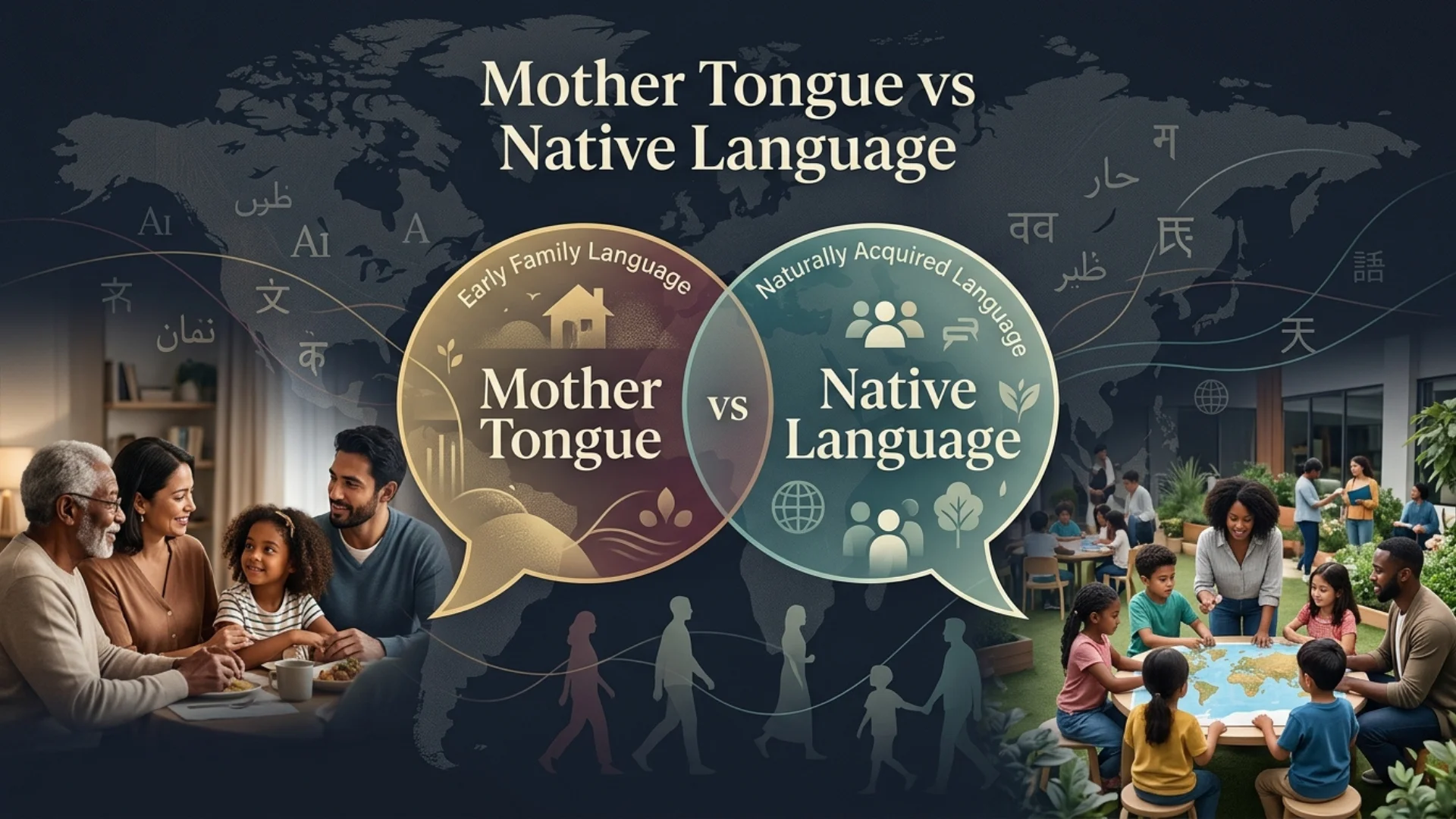
Mother tongue and native language usually refer to a language learned naturally during early childhood, and in many everyday situations they mean the same thing. However, the terms can differ slightly depending on family background, migration, bilingual upbringing, education, and how a person identifies with a language.
The simplest distinction is this:
Mother tongue often emphasizes the language connected with early family life, childhood, culture, or identity.
Native language usually emphasizes a language acquired naturally from early childhood rather than learned later through formal study.
For many people, both terms describe exactly the same language. For multilingual people, however, the answer can be more complicated.
Mother Tongue vs Native Language: Quick Answer
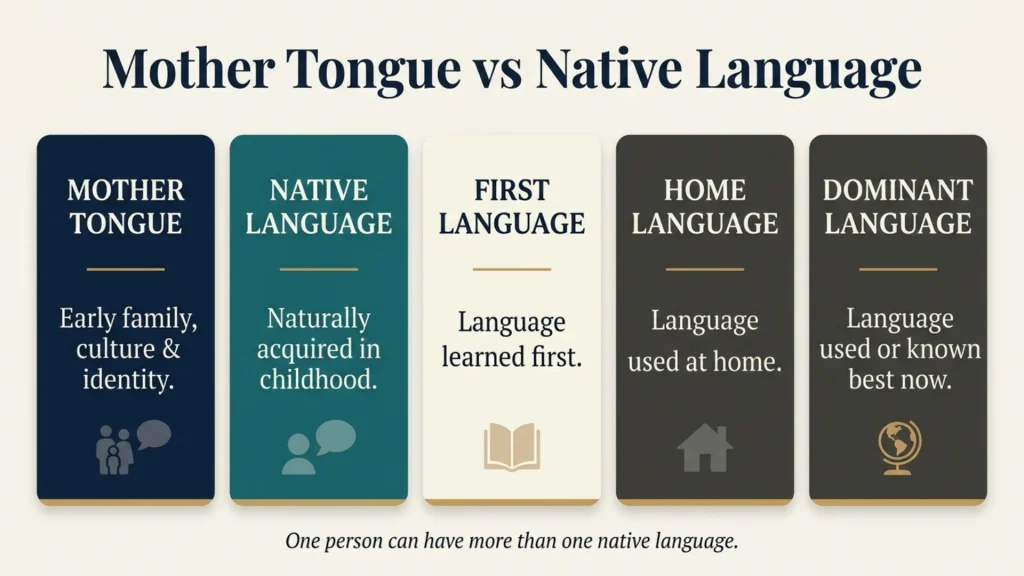
| Term | Usual Meaning | Main Emphasis |
|---|---|---|
| Mother tongue | Language learned early in childhood | Family, upbringing, culture, identity |
| Native language | Language naturally acquired in childhood | Natural acquisition and native-speaker ability |
| First language | Language learned first | Order of acquisition |
| Home language | Language used in the home | Current family/home use |
| Dominant language | Language a person currently uses or controls most strongly | Present-day proficiency and use |
| Second language | Language learned in addition to the first | Later acquisition or additional language |
In a simple monolingual case, mother tongue, native language, and first language can all refer to the same language.
In multilingual families, they may not line up so neatly.
What Is a Mother Tongue?
A mother tongue is commonly understood as the language a person first learns naturally in early childhood.
It is often the language spoken:
- by parents or caregivers
- inside the home
- with close family members
- during a person’s earliest years
For example:
Punjabi is her mother tongue because it was the language spoken in her family from birth.
The phrase can also carry a strong cultural or emotional association.
Someone may describe Punjabi, Arabic, Spanish, Bengali, Welsh, or another language as their mother tongue because it represents their family heritage and earliest linguistic environment.
What Is a Native Language?
A native language is a language a person acquires naturally through sustained exposure during childhood rather than learning only later through classes or deliberate study.
For example:
English is his native language because he grew up speaking it from early childhood.
A native speaker generally develops the language through ordinary childhood interaction rather than through formal foreign-language learning.
The phrase native tongue is essentially another way of saying native language.
Mother Tongue vs Native Language: Main Difference
The biggest mistake is treating them as two completely separate technical categories.
They often overlap.
The difference is mostly one of emphasis and context.
Mother Tongue Emphasizes Origin and Connection
Mother tongue often highlights:
- early family language
- home environment
- cultural background
- heritage
- identity
- childhood experience
Native Language Emphasizes Natural Acquisition
Native language usually highlights:
- acquisition during childhood
- natural rather than classroom learning
- intuitive command of a language
- early exposure
- native-speaker status
That distinction can be useful, but it is not a rigid universal rule.
Different institutions, researchers, countries, and individuals may use the labels differently.
Mother Tongue vs Native Language Comparison
| Question | Mother Tongue | Native Language |
|---|---|---|
| Learned in childhood? | Usually | Yes |
| Learned naturally? | Usually | Yes |
| Connected with family? | Often strongly | May be |
| Connected with culture? | Often | Can be |
| Can someone have more than one? | Yes | Yes |
| Must it be the language used most today? | No | No |
| Must it be the strongest language today? | No | No |
| Same as first language? | Often | Often |
| Same as home language? | Sometimes | Sometimes |
The last few rows are where human language does what it always does and refuses to fit nicely into a spreadsheet.
What Is a Native Language? Simple Definition
A simple native language definition is:
A language acquired naturally during early childhood through regular exposure.
For example, a child who grows up hearing and speaking both English and Urdu from infancy may acquire two native languages.
Being bilingual does not require one language to cancel out the other.
Define Native Tongue
Native tongue means essentially the same thing as native language.
Examples:
Spanish is her native tongue.
Spanish is her native language.
Both sentences are natural.
The word tongue has long been used figuratively to mean language or speech.
Can Mother Tongue and Native Language Be the Same?
Yes.
For millions of speakers, they are exactly the same in practical use.
For example, imagine someone who:
- was born into an Urdu-speaking family
- spoke Urdu at home from infancy
- grew up surrounded mainly by Urdu
- continues using Urdu regularly
That person could naturally say:
Urdu is my mother tongue.
And:
Urdu is my native language.
Neither statement creates a meaningful contradiction.
Can Mother Tongue and Native Language Be Different?
Sometimes, depending on how the speaker or institution defines the terms.
Consider a child born into a Punjabi-speaking family in an English-speaking country.
The child may:
- hear Punjabi from parents from birth
- use Punjabi with grandparents
- begin English very early through childcare and school
- eventually use English more frequently than Punjabi
- become highly proficient in both languages
The person might call Punjabi their mother tongue because of family and cultural connection while also describing English as a native language if it was naturally acquired early enough.
Other speakers might simply call both languages native languages.
Neither human language nor multilingual childhood comes with a dropdown menu containing one universally correct label.
Can You Have Two Native Languages?
Yes.
A child exposed naturally and substantially to two languages from early childhood can grow up as a native bilingual speaker.
For example:
- one parent speaks English
- another parent speaks Spanish
- the child regularly uses both from infancy
English and Spanish can both be native languages for that person.
The same is possible with three or more languages when substantial early exposure occurs.
Can You Have Two Mother Tongues?
Yes.
Some multilingual speakers describe themselves as having two mother tongues because they learned both languages naturally during their earliest years.
For example:
English and Arabic are both my mother tongues.
This can be perfectly reasonable for someone raised bilingually.
UNESCO also recognizes that the meaning of mother tongue can depend on context and that some people may have more than one. UNESCO on mother tongue and multilingual education
Mother Tongue vs First Language
Mother tongue and first language are often synonyms, but first language is somewhat more neutral and technical.
A first language, commonly abbreviated L1, generally refers to a language acquired first during childhood.
Example:
Her first language is Tamil.
This normally means Tamil was among the earliest languages she learned naturally.
When First Language Is Clearer
First language can be useful when you do not want to imply:
- that the language came specifically from the mother
- a cultural identity
- a particular nationality
- a single-language childhood
That makes first language common in education and language-learning discussions.
First Language vs Dominant Language
A person’s first language is not necessarily the language they speak best forever.
Imagine someone who:
- learns Korean in early childhood
- moves to Canada at age six
- receives all education in English
- works and socializes almost entirely in English for decades
Korean may remain their first language, while English eventually becomes their dominant language.
So:
First language = acquisition history
Dominant language = strongest or most-used language now
The two can change relative to each other over a lifetime.
Mother Tongue vs Home Language
A home language is the language currently used within a household.
That may be someone’s mother tongue, but it does not have to be.
For example:
A woman whose mother tongue is Arabic marries someone whose mother tongue is French. They decide to use English together at home.
In that household:
- Arabic may be her mother tongue
- French may be her partner’s mother tongue
- English may be their main home language
Again, one tidy label would apparently have been too convenient.
Mother Tongue vs Heritage Language
A heritage language is connected to a person’s family, ancestry, or cultural community.
It may be learned at home, but the speaker may not have full native proficiency in it.
For example, someone raised in the United States may identify Spanish as a heritage language because their family is Spanish-speaking, even if English became their strongest language.
That is different from automatically saying Spanish is their native language.
Native Language vs Fluent Language
Native and fluent do not mean the same thing.
Native Describes Acquisition
A native speaker generally acquired the language naturally during childhood.
Fluent Describes Ability
A fluent speaker can communicate smoothly and effectively in a language.
Someone can therefore be:
fluent but not native
Example:
A person begins learning English at age 14, studies and uses it intensively for 20 years, and becomes exceptionally fluent.
Their English may be excellent, but that does not retroactively make English a childhood native language.
Am I Native in English or Fluent?
Ask how you acquired English.
If you grew up speaking English naturally from early childhood, native English speaker may be appropriate.
If you learned English later but speak it extremely well, fluent in English is usually more precise.
Examples:
Native English speaker
Fluent in English
Bilingual in English and Spanish
Professional working proficiency in English
Avoid claiming native-speaker status simply as a synonym for “very good.”
Does a Native Speaker Need a Native Accent?
No single accent defines native status.
English alone has native speakers with:
- British accents
- American accents
- Australian accents
- Nigerian accents
- Indian English accents
- Irish accents
- New Zealand accents
- South African accents
- Singaporean accents
- many regional varieties
Native language is about acquisition and linguistic background, not sounding like one particular movie character from California.
Accent also varies by region, class, community, age, and individual experience.
Mother Tongue vs Native Language on a Form
If a form asks for mother tongue, it usually wants the language you first learned or your primary childhood/home language.
If it asks for native language, it normally wants a language acquired naturally in childhood.
If both fields appear separately, read the instructions carefully because the organization may have its own definitions.
When unsure, use the answer that best reflects your actual language history rather than trying to reverse-engineer what a database designer had in mind at 4:55 PM on a Friday.
What Should You Put on a Resume?
For most resumes, you do not need to write “mother tongue.”
A cleaner language section might say:
Languages
- Urdu — Native
- English — Fluent
- Punjabi — Conversational
Or:
- English — Native
- Spanish — Professional proficiency
- French — Intermediate
If you grew up genuinely bilingual:
- English — Native
- Arabic — Native
Do not use native merely as a stronger version of fluent.
For another example of how small wording differences change meaning, see “In Process” vs “In Progress”.
Is “Mother Tongue” Formal English?
Yes.
Mother tongue is an established standard English expression used in:
- education
- dictionaries
- language policy
- linguistics
- multilingual education
- ordinary conversation
It is not slang.
However, first language, home language, or native language may sometimes be more precise depending on what information is actually being discussed.
Is “Native Language” Politically Correct?
Native language is generally a normal and widely accepted term.
There is nothing inherently offensive about it.
However, some educators, researchers, or organizations may prefer terms such as:
- first language
- home language
- primary language
- heritage language
The best choice depends on what you actually mean.
For example, if you are asking which language a child uses at home, home language is more precise than native language.
If you are documenting acquisition order, first language may be better.
Precision usually solves more problems than hunting for one universally “politically correct” label.
What Can I Say Instead of Native Language?
Depending on context, alternatives include:
- first language
- mother tongue
- native tongue
- home language
- primary language
- L1
- heritage language
They are not perfect synonyms in every situation.
Choose based on what you want to describe.
Mother Language vs Mother Tongue
Mother tongue is the more common expression when discussing someone’s first language.
Mother language can sometimes be used similarly, but it also has another meaning in historical linguistics: a parent language from which other languages developed.
For ordinary personal language background, mother tongue is usually clearer.
Native Language vs National Language
These are completely different concepts.
A native language belongs to an individual’s language background.
A national language is a language associated officially or symbolically with a country.
A person can live in a country without having its national or official language as their native language.
For example, multilingual countries may recognize national or official languages spoken natively by only part of the population.
Native Language vs Official Language
An official language is designated for government, administration, law, education, or other official functions.
It does not tell you which language an individual learned first.
A citizen’s native language can therefore differ from the country’s official language.
Native Speaker vs Native Language
These expressions describe related but different things.
Native language describes the language.
Native speaker describes the person.
Example:
English is her native language.
She is a native speaker of English.
If you’re interested in other easily confused English expressions, Annunciate vs Enunciate explains another pair where similar-looking terms have different uses.
Native Language in Multilingual Countries
In multilingual societies, a person’s:
- family language
- school language
- dominant language
- official language
- community language
may all be different.
A child might speak one language with parents, another at school, and a third in the wider community.
That is why simplistic rules such as “your native language is the language of your country” fail quickly.
A country does not assign every citizen the same childhood linguistic history.
Example: Punjabi at Home and English at School
Suppose a child in England grows up in a Punjabi-speaking family.
From birth:
- parents speak Punjabi
- grandparents speak Punjabi
- family gatherings use Punjabi
At nursery and school:
- teachers use English
- classmates mainly use English
- media exposure is largely English
If both languages are acquired early and naturally, the person may reasonably describe themselves as a native speaker of both Punjabi and English.
They may still call Punjabi their mother tongue because of family and cultural connection.
The exact labels depend partly on how the speaker understands the terms.
Example: Spanish First, English Dominant Later
Imagine a child who speaks only Spanish until age five, then moves to the United States.
Over time, English becomes:
- the school language
- the work language
- the social language
- the strongest language
Spanish may remain the person’s:
- first language
- childhood language
- mother tongue
while English becomes their dominant language.
Whether they later describe English as a native language depends on how early and naturally they acquired it and which definition they are using.
Example: Two Languages From Birth
A child hears Japanese from one parent and English from another from infancy.
Both languages are used consistently.
That child may have:
two native languages
two first languages
and potentially two mother tongues, depending on terminology.
There is no rule stating that every human must have exactly one native language.
What Does “Native” Actually Tell You?
The word native in native language primarily points to early natural acquisition.
It does not automatically tell you:
- which language the person currently uses most
- which language they read best
- which language they write best
- where they live now
- their nationality
- their ethnicity
- their accent
- their education level
This distinction becomes especially important in multilingual communities.
Does Mother Tongue Always Come From the Mother?
No.
Despite the wording, mother tongue does not literally require the language to come from a person’s biological mother.
It can be acquired from:
- fathers
- grandparents
- siblings
- guardians
- extended family
- community members
- several caregivers
The expression refers to early language acquisition rather than a strict maternal transmission rule.
Can Your Mother Tongue Change?
The historical fact of which language you learned first does not change.
However, people’s relationships with languages can change dramatically.
Someone may:
- stop using their first language
- lose vocabulary
- become stronger in another language
- identify more strongly with another language
- relearn a childhood language later
Because mother tongue can also carry identity-based meanings in some contexts, people may describe their own linguistic background differently over time.
Can You Forget Your Native Language?
People can lose proficiency in a language they acquired early, a process generally called language attrition.
A person may still consider the language native or a first language historically even if another language becomes much stronger.
This is another reason native language and best language should not automatically be treated as synonyms.
Native Language vs Second Language
A second language is an additional language learned after or alongside a first language.
But the phrase does not necessarily mean the person is weak in it.
Someone’s second language can eventually become:
- highly fluent
- professionally dominant
- used more often than the first language
Acquisition history and present proficiency are separate questions.
Native Language vs Foreign Language
A foreign language is generally learned outside the learner’s primary linguistic environment or as an additional language.
For example:
A person living in Japan who studies Italian in a classroom may describe Italian as a foreign language.
But if that person later moves to Italy and uses Italian daily, it may become a major second or dominant language without becoming the language they originally acquired from infancy.
Why “Native Language” Does Not Mean Nationality
A person’s language background is not determined solely by passport or country of birth.
An American can grow up speaking Spanish.
A British citizen can grow up speaking Urdu.
A Canadian can have French and English as native languages.
A Pakistani can acquire English and Punjabi alongside Urdu.
Nationality describes citizenship or national identity.
Native language describes linguistic acquisition.
They intersect, but they are not the same category.
Common Mistakes
Mistake 1: Native Language Means the Language of Your Country
Not necessarily.
A country may contain hundreds of linguistic communities.
Mistake 2: You Can Have Only One Native Language
Incorrect.
Early bilingual or multilingual acquisition can produce multiple native languages.
Mistake 3: Fluent Means Native
Incorrect.
A person can become extremely fluent in a language learned later.
Mistake 4: Mother Tongue Must Be the Language Your Mother Speaks
No.
The phrase refers more broadly to early language acquisition and linguistic background.
Mistake 5: Your Strongest Language Must Be Your First Language
Not always.
Migration, schooling, work, and daily use can make another language dominant.
Mistake 6: Accent Proves Whether Someone Is Native
Not reliably.
Native speakers have countless regional and community accents.
Mother Tongue vs Native Language: Which Term Should You Use?
Use mother tongue when you want to emphasize:
- childhood family language
- cultural background
- heritage
- early home environment
Use native language when you want to emphasize:
- natural early acquisition
- native-speaker status
- childhood linguistic competence
Use first language when you want a relatively neutral term focused on acquisition order.
Use home language when you literally mean the language used at home.
Use dominant language when you mean the language a person currently uses or controls most strongly.
That five-way distinction handles most real-world situations much better than forcing everything into one label.
For another guide about choosing between two apparently similar expressions, see Hola or Ola?.
Frequently Asked Questions
Is Native Language the Same as Mother Tongue?
Often, yes.
Both commonly describe a language acquired naturally in early childhood.
However, mother tongue can place more emphasis on family, heritage, identity, or the earliest home environment, while native language tends to emphasize natural childhood acquisition.
In multilingual situations, individual usage may differ.
What’s the Difference Between First Language and Mother Tongue?
A first language refers primarily to the language or languages acquired first.
Mother tongue often means the same thing but can also carry family, cultural, or identity associations.
For many people, there is no practical difference.
Am I Native in English or Fluent?
If you acquired English naturally during early childhood, native English speaker may be accurate.
If you learned English later and became highly proficient, fluent in English is usually the more precise description.
Fluency does not require native acquisition.
Is Native Language Politically Correct?
Yes, native language is generally a standard and neutral term.
However, first language, home language, or primary language may be more precise in certain educational, demographic, or multilingual contexts.
What Can I Say Instead of Native Language?
Depending on context, you can use:
- first language
- mother tongue
- native tongue
- home language
- primary language
- L1
Do not assume every alternative means exactly the same thing.
Is It Racist to Say “Speak English”?
The phrase itself is not automatically racist.
Context matters.
A neutral request to use a shared language for communication can be reasonable. Directing “speak English” at someone because of their ethnicity, accent, or perceived foreignness in order to demean or exclude them can be discriminatory or racist.
Meaning depends on who is saying it, why, where, and how.
Who Spoke English First, Britain or America?
English developed in England centuries before the United States existed.
The language developed from Germanic varieties brought to Britain during the early medieval period and later changed through contact with Norse, French, Latin, and other languages.
American English developed much later from English varieties carried to North America.
What Is the Hardest American Dialect to Understand?
There is no objectively “hardest” American dialect.
Difficulty depends on the listener’s experience.
Someone accustomed to General American English may initially find unfamiliar regional varieties, fast local speech, or strong community-specific vocabulary harder to follow.
Familiarity usually matters more than any universal difficulty ranking.
Can a Non-White Person Be English?
Yes.
Being English is not restricted to one race.
A person can identify as English through nationality, upbringing, culture, family background, or personal identity regardless of skin color or ethnic ancestry.
Final Answer
For Mother Tongue vs Native Language, the two terms are often interchangeable but are not perfectly identical in every context.
Mother tongue usually emphasizes a person’s earliest family, childhood, cultural, or heritage language.
Native language usually emphasizes a language acquired naturally during early childhood.
First language focuses on acquisition order.
Home language focuses on what is spoken at home.
Dominant language focuses on which language is strongest or used most now.
For a monolingual speaker, all of these may point to one language.
For a multilingual speaker, they can describe different parts of the same linguistic life.
The useful rule is not to ask, “Which one is always correct?”
Ask:
What exactly am I trying to describe: childhood acquisition, family identity, current use, or present proficiency?
Once that is clear, the right term usually becomes obvious.