Anyone Has or Anyone Have? Correct Grammar, Rules & Examples
Quick Answer: Both “anyone has” and “anyone have” can appear in correct English, but they belong in different sentence structures.
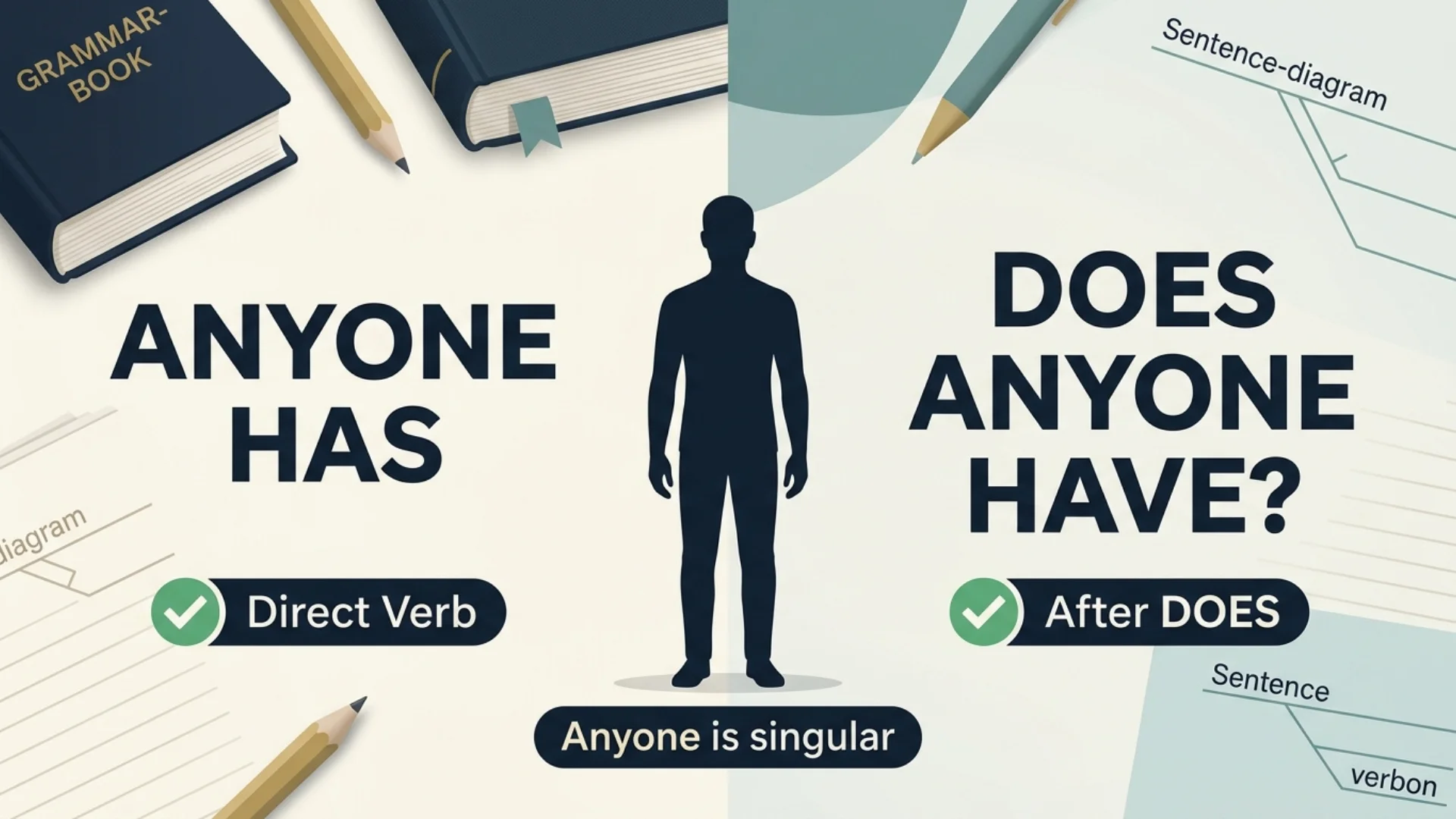
Use has when anyone directly takes the present-tense verb:
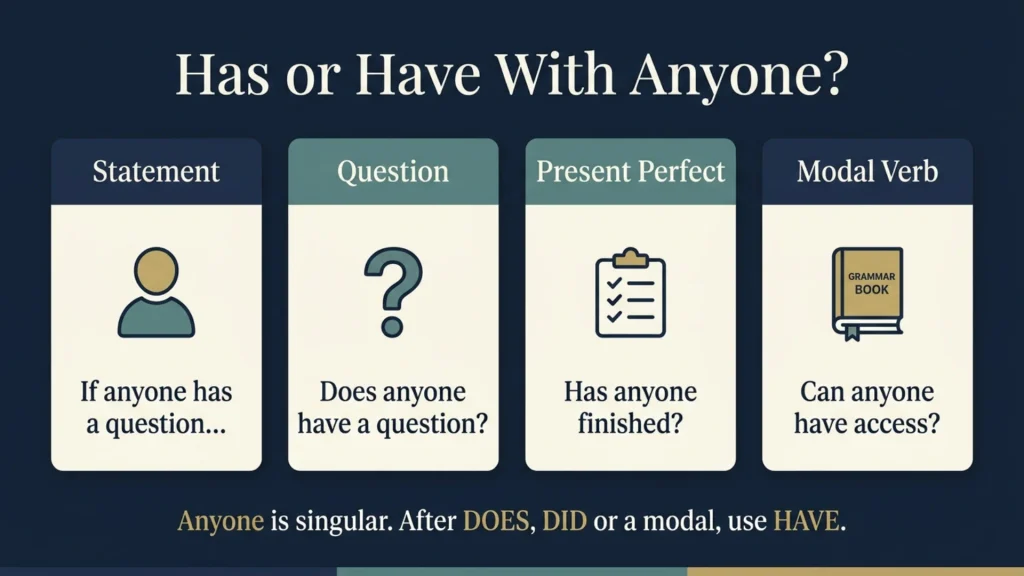
If anyone has a question, please ask.
Use have after does, did, can, could, will, would, may, might, must, should, and similar auxiliary or modal verbs:
Does anyone have a question?
Can anyone have access?
Do not write:
Does anyone has a question? ❌
The core rule is:
Anyone is grammatically singular.
But after does, the main verb returns to its base form:
does + anyone + have
not:
does + anyone + has
Anyone Has or Anyone Have at a Glance
| Sentence Pattern | Correct Form | Example |
|---|---|---|
| anyone + present verb | has | If anyone has a question, ask. |
| does + anyone + verb | have | Does anyone have a pen? |
| did + anyone + verb | have | Did anyone have trouble? |
| can + anyone + verb | have | Can anyone have access? |
| anyone who + verb | has | Anyone who has a ticket may enter. |
| anyone that + verb | has | Anyone that has access can log in. |
| informal shortened question | have | Anyone have a charger? |
| present perfect question | has | Has anyone seen my keys? |
The most common mistake is thinking that anyone changes from singular to plural in a question.
It does not.
The reason we say have in “Does anyone have?” is that does already carries the third-person singular marking.
Is Anyone Singular or Plural?
Anyone is a singular indefinite pronoun.
Cambridge Grammar states that anyone, anybody, and anything are used with a singular verb. You can see the Cambridge Grammar explanation of anyone and anybody.
That means:
Anyone is welcome. ✅
Anyone has the right to apply. ✅
Anyone wants to help. ✅
Not:
Anyone are welcome. ❌
Anyone have the right to apply. ❌
Anyone want to help. ❌
There are special structures where the base verb have appears, but that does not make anyone plural.
Why Is “Anyone” Singular?
Think of anyone as meaning:
any one person
You may be talking about a potentially unlimited group of people, but grammatically the pronoun selects one unspecified person at a time.
Compare:
Anyone has access after registering.
The meaning is:
Any one person has access after registering.
That singular idea controls subject-verb agreement.
When to Use “Anyone Has”
Use anyone has when anyone directly acts as the subject of the present-tense verb has.
Examples:
If anyone has a question, let me know.
Anyone has the right to request assistance.
I don’t think anyone has the answer.
Anyone who has a ticket can enter.
Before anyone has access, they must register.
The pattern is:
anyone + has
because anyone is singular.
Is “Anyone Has” Always Natural?
It can be grammatically correct without being the most natural wording in every sentence.
For example:
Anyone has the right to complain.
is grammatical, but many speakers would naturally write:
Anyone can complain.
or:
Everyone has the right to complain.
By contrast:
If anyone has questions, please ask.
sounds completely natural.
So grammar and style are separate issues.
The form anyone has is valid, but the sentence around it still needs to sound idiomatic.
When to Use “Anyone Have”
Use have when another verb already carries the tense or agreement.
The most common example is:
Does anyone have…?
Examples:
Does anyone have a pen?
Does anyone have any questions?
Does anyone have experience with Excel?
Does anyone have the password?
Here:
does = third-person singular auxiliary
have = base form of the main verb
The structure is:
Does + anyone + have
Why Is “Does Anyone Have” Correct?
English normally uses the base form of the main verb after do, does, or did.
Compare:
She has a car.
But:
Does she have a car?
Not:
Does she has a car? ❌
The same rule applies to anyone:
Anyone has access.
but:
Does anyone have access?
Not:
Does anyone has access? ❌
Does Anyone Has or Have?
The correct form is:
Does anyone have…?
Not:
Does anyone has…?
Examples:
Does anyone have a charger? ✅
Does anyone have the document? ✅
Does anyone have an answer? ✅
Does anyone has a charger? ❌
Does anyone has the document? ❌
The auxiliary does already contains the singular verb agreement, so adding has would mark the verb twice.
Does Anyone Have or Has?
Use:
Does anyone have
Example:
Does anyone have a spare key?
Do not use:
Does anyone has a spare key?
This rule applies regardless of whether you are speaking formally or casually.
Do Anyone Have or Does Anyone Have?
The standard form is:
Does anyone have…?
because anyone is singular.
Correct:
Does anyone have a suggestion?
Incorrect:
Do anyone have a suggestion?
Compare:
Do people have suggestions?
Here people is plural, so do is correct.
But:
Does anyone have a suggestion?
uses singular anyone, so does is required.
For another subject-verb agreement comparison, see GrammarRead’s guide to People Do or People Does.
“Anyone Have?” in Informal Speech
You may hear:
Anyone have a pen?
Anyone have a charger?
Anyone have any ideas?
These are common shortened questions in informal speech.
The full standard form is:
Does anyone have a pen?
In conversation, speakers often omit does.
So:
Anyone have a pen?
can be acceptable as an informal conversational question.
In formal writing, exams, business documents, and academic work, use:
Does anyone have a pen?
Anyone Who Has or Anyone Who Have?
Use:
anyone who has
because anyone is singular.
Correct:
Anyone who has experience may apply.
Anyone who has a ticket can enter.
Anyone who has completed the form may leave.
Incorrect:
Anyone who have experience may apply.
The relative pronoun who refers back to anyone, so the verb remains singular.
Anyone That Has or Have?
The standard agreement is:
anyone that has
Example:
Anyone that has access can view the file.
However, because anyone refers to a person, who often sounds more natural than that:
Better:
Anyone who has access can view the file.
Both structures may occur, but who is generally the more natural relative pronoun for people.
Anyone Who Have or Has?
Use:
anyone who has
The pattern is:
anyone → singular
therefore:
who has
Example:
Anyone who has information should contact us.
Not:
Anyone who have information should contact us.
If Anyone Has or Have?
Use:
if anyone has
Example:
If anyone has a question, please ask.
If anyone has concerns, contact me.
If anyone has seen my phone, let me know.
In normal modern English, do not write:
If anyone have a question…
The ordinary conditional does not change the singular agreement of anyone.
“I Don’t Think Anyone Has” or “Have”?
Use:
I don’t think anyone has…
Example:
I don’t think anyone has finished yet.
The word don’t belongs to the first clause:
I don’t think
The second clause has its own subject and verb:
anyone has finished
So the presence of don’t earlier in the sentence does not turn has into have.
Anyone Has Been or Anyone Have Been?
Use:
anyone has been
when anyone directly takes the present perfect verb.
Example:
I don’t think anyone has been there before.
But in a question:
Has anyone been there before?
Both use has because has is the auxiliary of the present perfect.
Do not use:
Have anyone been there before? ❌
Has Anyone or Have Anyone?
Use:
Has anyone…?
Examples:
Has anyone called?
Has anyone seen my keys?
Has anyone finished the report?
Has anyone been here before?
Not:
Have anyone called?
Because anyone is singular, the present-perfect auxiliary is has.
Has Anybody or Have Anybody?
The same rule applies to anybody.
Use:
Has anybody…?
Examples:
Has anybody called?
Has anybody seen this before?
Not:
Have anybody called?
Anyone Has Seen or Anyone Have Seen?
Use:
anyone has seen
when it appears inside a statement:
I doubt anyone has seen the file.
Question:
Has anyone seen the file?
Not:
I doubt anyone have seen the file.
Not:
Have anyone seen the file?
Anyone Has Done or Anyone Have Done?
Use:
anyone has done
Example:
I don’t know whether anyone has done this before.
Question:
Has anyone done this before?
The same present-perfect rule applies.
Someone Has or Have?
Someone is also singular.
Use:
someone has
Example:
Someone has taken my seat.
Question:
Does someone have the key?
Not:
Someone have taken my seat.
Not:
Does someone has the key?
Does Someone Has or Have?
Use:
Does someone have…?
Example:
Does someone have a copy of the report?
This follows exactly the same rule as:
Does anyone have…?
After does, use the base form:
have
Somebody Has or Have?
Use:
somebody has
Example:
Somebody has left their phone here.
Question:
Does somebody have a charger?
Not:
Somebody have left their phone here.
Does Somebody Has or Have?
Correct:
Does somebody have…?
Incorrect:
Does somebody has…?
Again:
does + base verb
Anybody Has or Anybody Have?
The basic rule is:
Anybody has…
when anybody directly controls the present verb.
Example:
If anybody has questions, please ask.
But:
Does anybody have questions?
because does requires have.
Everybody Has or Have?
Use:
everybody has
because everybody is grammatically singular.
Correct:
Everybody has a role.
Question:
Does everybody have a role?
Not:
Everybody have a role.
Not:
Does everybody has a role?
Everyone Has or Have?
Use:
everyone has
Example:
Everyone has a responsibility.
Question:
Does everyone have access?
Again, the noun may refer to many people semantically, but its grammatical agreement is singular.
No One Has or Have?
Use:
no one has
Example:
No one has the answer.
Question:
Does no one have access?
The latter is grammatical, although context may make Doesn’t anyone have access? sound more natural.
Nobody Has or Have?
Use:
nobody has
Example:
Nobody has called yet.
Not:
Nobody have called yet.
Question:
Does nobody have the key?
Singular Indefinite Pronouns With Has
These indefinite pronouns generally take singular verb agreement:
| Pronoun | Correct Present Form |
|---|---|
| anyone | has |
| anybody | has |
| someone | has |
| somebody | has |
| everyone | has |
| everybody | has |
| no one | has |
| nobody | has |
| each | has |
| either | has |
| neither | has |
Examples:
Everyone has arrived.
Nobody has answered.
Each has a different purpose.
Neither has worked.
Why Singular “Anyone” Can Use Singular “They”
A common source of confusion is:
If anyone has questions, they should ask.
Some learners see they and assume anyone must be plural.
It is not.
Modern English commonly uses singular they when a person’s gender is unknown or irrelevant.
So:
anyone has
remains singular verb agreement, while:
they
can refer back to that singular indefinite person.
Example:
If anyone has forgotten their ID, they should speak to reception.
There is no contradiction.
Each Has or Each Have?
When each itself is the subject, use:
each has
Example:
Each has a different role.
Each of the students has a book.
Not:
Each of the students have a book.
In careful standard English, each normally triggers singular agreement.
Each of You Has or Each of You Have?
Use:
Each of you has
Example:
Each of you has a responsibility.
The subject is each, not you.
Therefore:
has
is correct.
Why Can We Say “You Each Have”?
This is a different structure.
Compare:
Each of you has a ticket.
Subject = each
But:
You each have a ticket.
Subject = you
Because you takes have, the correct verb changes.
So both can be correct:
Each of you has a ticket.
You each have a ticket.
Word order matters.
People Have or People Has?
Use:
people have
because people is plural.
Correct:
People have different opinions.
Incorrect:
People has different opinions.
Compare:
Anyone has the opportunity to apply.
People have the opportunity to apply.
The grammatical number is different.
Who Has or Who Have?
Both forms can be correct depending on what who refers to.
Who Has
When asking about an unknown singular person:
Who has the key?
Who Have
When who refers back to a plural noun:
The employees who have access must sign in.
Here who refers to employees, so the verb is plural.
Compare:
Anyone who has access…
because anyone is singular.
People who have access…
because people is plural.
Anyone Who Has vs People Who Have
This pair makes the agreement particularly clear.
Anyone who has a ticket may enter.
But:
People who have tickets may enter.
Anyone = singular.
People = plural.
The relative clause follows the number of the word it refers to.
None Has or None Have?
This case is more flexible than anyone.
Both singular and plural agreement can occur with none, depending on meaning and style.
Example:
None of the money has been recovered.
Singular makes sense because money is uncountable.
But:
None of the students have arrived.
Plural agreement is common because the sentence refers to multiple students.
You may also encounter:
None of the students has arrived.
especially when none is interpreted as not one.
So unlike anyone, none does not always force one simple agreement pattern.
None of Them Has or Have?
Both can occur.
Common modern usage:
None of them have finished.
More strictly singular interpretation:
None of them has finished.
The plural form is extremely common when them refers to multiple people.
This flexibility should not be transferred to anyone, which takes singular agreement when directly governing a verb.
Does Anyone Has Any Questions?
Incorrect:
Does anyone has any questions?
Correct:
Does anyone have any questions?
The correct pattern is:
does + anyone + have
This is probably the most common error involving this grammar point.
Does Anyone Have Any Questions?
Yes. This is completely correct and natural.
Example:
Does anyone have any questions before we finish?
It is one of the most common uses of anyone in everyday English.
Does Anyone Have This?
Correct:
Does anyone have this book?
Does anyone have this problem?
Does anyone have this app installed?
Casually, speakers may shorten it to:
Anyone have this?
That shortened version is conversational rather than the best choice for formal prose.
Anyone Have This?
In informal speech and messaging:
Anyone have this?
is common.
The full standard question is:
Does anyone have this?
For essays, professional emails, formal documents, and grammar tests, use the full form.
Have Anyone or Has Anyone?
When asking a present-perfect question, use:
Has anyone…?
Correct:
Has anyone contacted you?
Incorrect:
Have anyone contacted you?
But remember that have anyone can occur in a completely different construction:
Did you have anyone help you?
Here you, not anyone, controls have.
That is a different grammar pattern.
Do Anybody Have or Does Anybody Have?
Use:
Does anybody have…?
because anybody is singular.
Correct:
Does anybody have the answer?
Incorrect:
Do anybody have the answer?
Anyone Has vs Anyone Have in Questions
Standard questions usually use does + have:
Does anyone have time?
Does anyone have a suggestion?
Does anyone have experience?
You do not normally form the question by simply reversing anyone has into:
Has anyone a suggestion?
In some varieties or formal constructions, Have you…? patterns exist with possession, but ordinary modern usage strongly favors:
Does anyone have…?
Anyone Has vs Anyone Have in Negative Sentences
Consider:
I don’t think anyone has access.
Here, has is correct because:
anyone has access
is its own embedded clause.
Now compare:
Doesn’t anyone have access?
Here:
doesn’t + anyone + have
uses the base verb.
Correctness depends on which auxiliary belongs to the clause containing anyone.
Anyone Has vs Anyone Have With Modal Verbs
After modal verbs, use the base verb have.
Examples:
Anyone can have an opinion.
Anyone may have questions.
Anyone might have difficulty.
Anyone could have made that mistake.
Anyone should have access.
Anyone would have noticed.
Not:
Anyone can has an opinion. ❌
Modal verbs always take the base form of the main verb.
Can Anyone Has or Have?
Correct:
Can anyone have…?
Not:
Can anyone has…?
Example:
Can anyone have access to this account?
The same applies to:
- could anyone have
- may anyone have
- might anyone have
- should anyone have
- would anyone have
Did Anyone Has or Have?
Use:
Did anyone have…?
Correct:
Did anyone have trouble logging in?
Incorrect:
Did anyone has trouble logging in?
After did, use the base form have.
Past tense is already expressed by did.
Will Anyone Has or Have?
Use:
Will anyone have…?
Example:
Will anyone have time tomorrow?
Not:
Will anyone has time tomorrow?
Again, the modal will requires the base form.
A Simple Has vs Have Rule
Use this shortcut:
No Helping Verb
anyone has
Example:
If anyone has time, please help.
Does / Did
anyone have
Example:
Does anyone have time?
Modal Verb
anyone have
Example:
Can anyone have access?
Present Perfect
has anyone + past participle
Example:
Has anyone finished?
This one pattern handles nearly every common search variation.
Has vs Have With Other Subjects
| Subject | Correct Form |
|---|---|
| I | have |
| you | have |
| we | have |
| they | have |
| people | have |
| he | has |
| she | has |
| it | has |
| anyone | has |
| someone | has |
| everyone | has |
| anybody | has |
| nobody | has |
| each | has |
This is ordinary subject-verb agreement.
GrammarRead’s guide to Was There or Were There covers another situation where singular and plural agreement changes the correct verb form.
Common Mistakes With Anyone Has and Anyone Have
Mistake 1: Does Anyone Has
Incorrect:
Does anyone has a pen?
Correct:
Does anyone have a pen?
Mistake 2: Do Anyone Have
Incorrect:
Do anyone have a pen?
Correct:
Does anyone have a pen?
Mistake 3: If Anyone Have
Incorrect in ordinary modern English:
If anyone have questions, ask me.
Correct:
If anyone has questions, ask me.
Mistake 4: Anyone Who Have
Incorrect:
Anyone who have access can enter.
Correct:
Anyone who has access can enter.
Mistake 5: Have Anyone Seen
Incorrect:
Have anyone seen Sarah?
Correct:
Has anyone seen Sarah?
Mistake 6: Treating Singular They as Plural Agreement
Correct:
If anyone has forgotten their password, they can reset it.
The pronoun they does not make anyone plural.
Anyone vs Anybody
Anyone and anybody have essentially the same grammar.
Examples:
Does anyone have a question?
Does anybody have a question?
If anyone has concerns, tell me.
If anybody has concerns, tell me.
Both words are singular.
In style, anyone can feel slightly more neutral or formal, while anybody often sounds conversational.
Anyone vs Someone
Use anyone when the identity is open or unspecified.
Does anyone have a charger?
Use someone when referring to one unspecified person whose existence is more definite.
Someone has taken my charger.
Both are grammatically singular:
anyone has
someone has
Anyone vs Everyone
Anyone means any one person without specifying which.
Everyone refers to every person in the group.
Compare:
Anyone can apply.
Everyone has applied.
Both take singular verb agreement when they directly control the verb.
Anyone vs People
This is where semantic meaning can mislead learners.
Anyone may refer to a huge possible group, but grammatically it is singular:
Anyone has the opportunity to apply.
People is grammatically plural:
People have opportunities to apply.
So:
anyone has
but:
people have
Formal vs Informal Usage
Formal
Does anyone have any questions?
If anyone has concerns, please contact the office.
Anyone who has completed the form may proceed.
Informal
Anyone have a charger?
Anyone got a pen?
Shortened conversational questions are normal in speech, messaging, and group chats.
They should not automatically be copied into formal writing.
Anyone Has or Anyone Have in Emails
Professional email:
If anyone has questions about the schedule, please contact me.
Question to a team:
Does anyone have the latest version of the report?
Less formal team chat:
Anyone have the latest report?
All three can work in the appropriate setting.
For another common email and communication word-choice issue, see Respond vs. Response.
Anyone Has or Anyone Have in Exams
For grammar tests and formal academic writing, follow standard structures:
If anyone has…
Does anyone have…?
Has anyone…?
Anyone who has…
Avoid shortened conversational forms such as:
Anyone have…?
unless the exercise specifically asks about informal spoken English.
Anyone Has or Anyone Have: 20 Correct Examples
- If anyone has a question, please ask.
- Does anyone have a spare pen?
- Anyone who has a ticket may enter.
- Has anyone seen my phone?
- I don’t think anyone has called yet.
- Does anyone have experience with Python?
- If anyone has feedback, send it today.
- Anyone can have a bad day.
- Did anyone have difficulty with the test?
- Will anyone have time tomorrow?
- Has anyone finished the assignment?
- Does anybody have the answer?
- Someone has taken my chair.
- Everyone has a responsibility.
- Nobody has complained.
- Each of you has a different task.
- You each have a different task.
- People have different opinions.
- Anyone who has access must sign in.
- Can anyone have more than one account?
12 Incorrect Examples and Corrections
| Incorrect | Correct |
|---|---|
| Does anyone has a pen? | Does anyone have a pen? |
| Do anyone have a pen? | Does anyone have a pen? |
| If anyone have questions, ask. | If anyone has questions, ask. |
| Anyone who have access can enter. | Anyone who has access can enter. |
| Have anyone called? | Has anyone called? |
| Does somebody has a key? | Does somebody have a key? |
| Someone have my notebook. | Someone has my notebook. |
| Everybody have a role. | Everybody has a role. |
| Do anybody have an answer? | Does anybody have an answer? |
| Each of you have a ticket. | Each of you has a ticket. |
| People has different opinions. | People have different opinions. |
| Did anyone has trouble? | Did anyone have trouble? |
Easy Trick to Remember
Remember two lines:
Anyone HAS
but:
Does anyone HAVE?
Why?
Because only one verb needs to show the third-person singular marking.
In:
Anyone has
the marking appears on has.
In:
Does anyone have
the marking appears on does.
English does not need:
does + has
because that would mark the same grammatical information twice.
Frequently Asked Questions
Which is correct: anyone has or anyone have?
Both can appear in correct English depending on structure. Use anyone has when anyone directly takes the verb, and have after auxiliaries or modals, as in Does anyone have…?
Does anyone has or have?
Use Does anyone have…? The form does anyone has is incorrect in standard English because the main verb stays in its base form after does.
Is “anyone have” grammatically correct?
Yes, in structures such as Does anyone have…? or after modal verbs such as Can anyone have…? It also occurs as a shortened informal question: Anyone have a pen?
Is “anyone has” correct?
Yes. Anyone is singular, so has is correct when it directly takes a present-tense verb: If anyone has questions, please ask.
Anyone who has or have?
Use anyone who has because who refers back to the singular pronoun anyone.
Anyone that has or have?
Use anyone that has, although anyone who has often sounds more natural because anyone refers to a person.
Do anyone have or does anyone have?
Use Does anyone have…? Anyone is singular, so the correct auxiliary is does.
Has anyone or have anyone?
Use Has anyone…? in present-perfect questions: Has anyone seen my keys?
Somebody has or have?
Use somebody has when somebody directly controls the verb: Somebody has called. In a question, use Does somebody have…?
Someone has or have?
Use someone has in statements and Does someone have…? in questions.
Anybody has or have?
Use anybody has when anybody directly governs the verb, but Does anybody have…? in a question.
Each of you has or each of you have?
Use Each of you has because each is the grammatical subject. However, You each have is correct because you becomes the subject.
Who has or who have?
Both are possible. Use who has for a singular antecedent or unknown individual, but who have when who refers to a plural noun: People who have tickets may enter.
People have or people has?
Use people have because people is plural.
None has or none have?
Both can occur depending on meaning. None has reflects a singular “not one” interpretation, while plural agreement such as None of them have arrived is also common and standard.
Final Answer
The Anyone Has or Anyone Have rule becomes simple once you separate subject-verb agreement from auxiliary verbs.
Use:
Anyone has…
when anyone directly takes the present-tense verb.
Example:
If anyone has questions, please ask.
Use:
Does anyone have…?
because does already carries the singular agreement and have stays in its base form.
Example:
Does anyone have a question?
Also remember:
Anyone who has… ✅
Has anyone…? ✅
Did anyone have…? ✅
Can anyone have…? ✅
Someone has… ✅
Does somebody have…? ✅
Each of you has… ✅
You each have… ✅
People have… ✅
The key fact never changes:
Anyone is grammatically singular.
What changes is the sentence structure around it.