Gauging Interest vs Gaging Interest: Meaning, Spelling & Examples
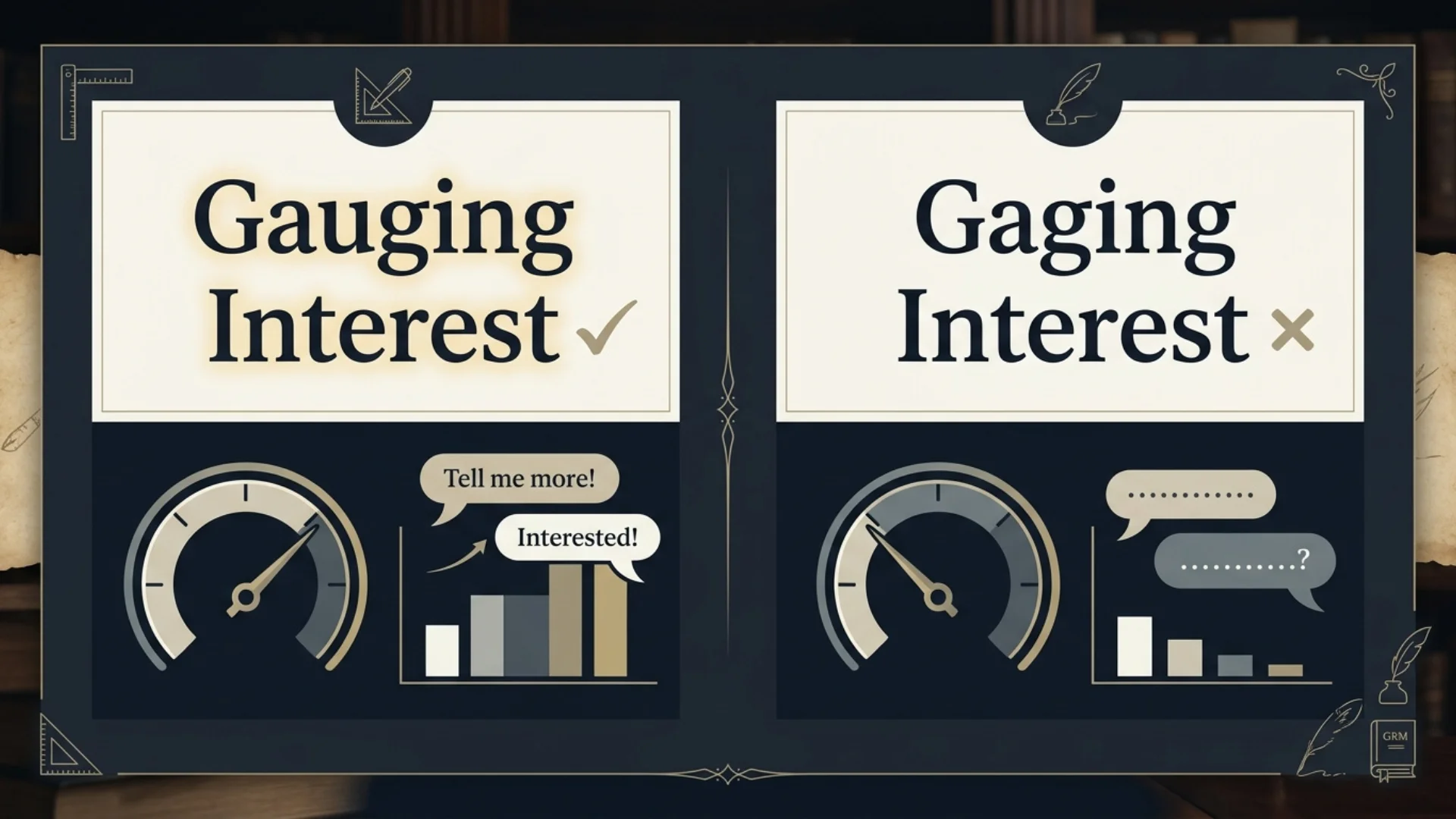
“Gauging interest” is the standard phrase in modern English. It means measuring, estimating, or assessing how interested people are in an idea, product, event, proposal, or opportunity.
“Gaging interest” is much less common. The spelling gage does exist as a word in English and appears in some dictionary senses, but when you mean “estimate or assess interest,” gauge and gauging are the forms most readers expect.
So if you are writing an email, survey, social post, business proposal, school assignment, or article, the safest choice is:
We are gauging interest in the new program.
Gauging Interest vs Gaging Interest: Quick Answer
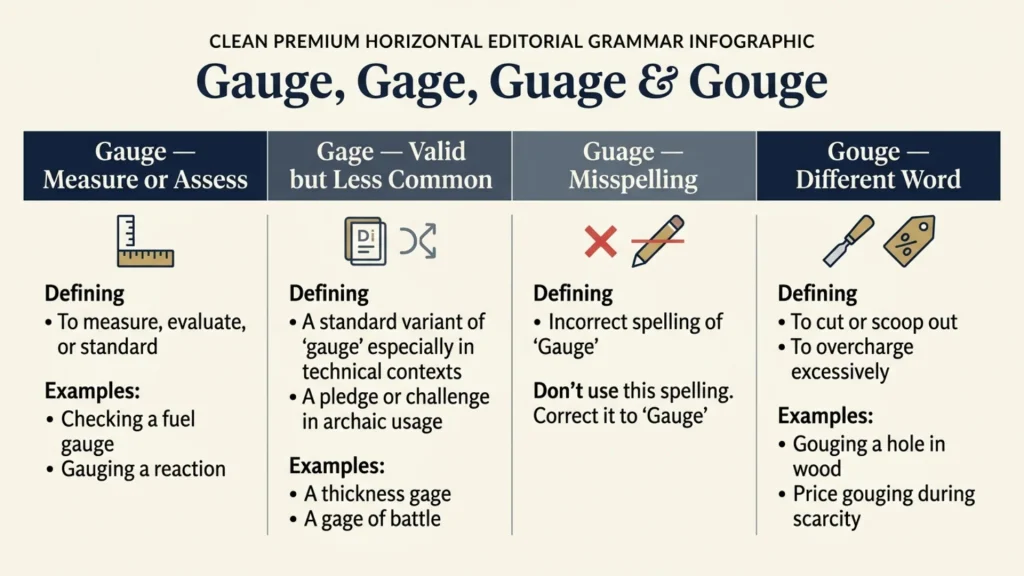
| Phrase | Status | Best Use |
|---|---|---|
| gauging interest | Standard and natural | Use this in normal modern English |
| gaging interest | Possible from the variant word gage, but uncommon | Usually avoid unless following a specific house style or source |
| guaging interest | Misspelling | Correct to gauging interest |
| gouging interest | Wrong word | Gouging means something entirely different |
What Does “Gauging Interest” Mean?
Gauging interest means trying to determine how interested people are in something before making a decision or taking action.
You might gauge interest before:
- launching a new product
- planning an event
- starting a course
- creating a club or community
- offering a new service
- changing a work policy
- opening registrations
- investing money in a project
In other words, you are not measuring interest with a literal physical instrument. You are estimating, assessing, or evaluating it.
Merriam-Webster lists gauge among verbs used in the sense of estimating or judging. See the Merriam-Webster definition of gauge for the standard dictionary treatment.
Examples of Gauging Interest in a Sentence
- We are gauging interest in a weekend workshop.
- The company sent a survey to gauge customer interest.
- She posted online to gauge interest in the event.
- Before ordering stock, the store is gauging interest in the new product.
- The school is gauging parent interest in an after-school program.
- We are trying to gauge interest before booking a larger venue.
- The developer created a waiting list to gauge interest in the app.
- The team used preorders to gauge interest in the new design.
- They are gauging public interest before announcing the project.
- I am gauging interest in starting a monthly book club.
- The manager asked employees to complete a poll to gauge interest.
- The organizers are gauging interest in an additional session.
- A short questionnaire can help gauge your audience’s interest.
- We should gauge interest before committing the full budget.
- The post was mainly intended to gauge interest in the idea.
Gauge Interest Meaning
To gauge interest means to estimate the amount or level of interest someone or a group has in something.
For example:
“We want to gauge interest in a second class.”
This means:
“We want to find out how many people may be interested in a second class.”
Gauge Your Interest Meaning
Gauge your interest means assess or estimate how interested you are in something.
Example:
“Try the free lesson first to gauge your interest in the course.”
The sentence suggests trying the lesson before deciding whether the subject interests you enough to continue.
Gauging or Gaging: Which Spelling Should You Use?
For ordinary modern writing, use gauging.
The base word is:
gauge
When adding -ing, the final silent e is dropped:
gauge → gauging
This is similar to:
- make → making
- write → writing
- use → using
- change → changing
If irregular English spellings regularly make you suspicious of perfectly innocent vowels, the related GrammarRead guide on combating vs combatting covers another spelling pattern that causes similar hesitation.
Is “Gaging” a Word?
Yes, gaging can exist as a form of the word gage. That does not make it the best spelling for every context.
The important distinction is practical usage:
- gauge is the standard spelling for measuring or estimating
- gauging is the standard -ing form in that sense
- gage exists in English, but is less common for the “measure or estimate” sense in general writing
- gaging interest may therefore look unusual or mistaken to many readers
If your purpose is clarity, gauging interest wins.
Gauge or Gage Interest?
Use:
gauge interest
rather than:
gage interest
in normal contemporary prose.
Examples:
Correct and natural:
We want to gauge interest in the new service.
Unusual:
We want to gage interest in the new service.
The second sentence may be interpretable, but the first is what most readers expect.
Why Is “Gauging” Spelled That Way?
The spelling looks odd because gauge already has an unusual sequence of vowels.
When -ing is added:
gauge + ing → gauging
The final e disappears, leaving:
g-a-u-g-i-n-g
Not:
- gaugeing
- guaging
- gaging, if you mean the standard verb gauge
English spelling remains committed to keeping everyone humble. GrammarRead’s guide to Goodbye vs Good Bye vs Good-bye is another example of a familiar word producing far more spelling debate than seems morally necessary.
Guage Interest vs Gauge Interest
Guage is a common misspelling of gauge.
Correct:
We need to gauge interest.
Incorrect:
We need to guage interest.
The correct letter order is:
G-A-U-G-E
Gague Interest: Is It Correct?
No. Gague is also a misspelling.
Use:
gauge interest
and:
gauging interest
Gauging vs Gouging
Gauging and gouging are completely different words.
| Word | General Meaning | Example |
|---|---|---|
| gauging | measuring, estimating, assessing | We are gauging interest. |
| gouging | cutting, digging out, or charging an unfairly high price | The company was accused of price gouging. |
So:
We are gouging interest
does not mean you are assessing anyone’s interest. It mostly sounds like interest has suffered an unfortunate industrial accident.
Gauge Interest Synonyms
Depending on context, you can replace gauge interest with:
- assess interest
- measure interest
- estimate interest
- evaluate interest
- test interest
- determine interest
- check interest
- survey interest
- explore interest
- identify demand
- assess demand
- test demand
More Natural Alternatives in Business Writing
Instead of:
We are gauging interest in the program.
You could write:
- We are assessing demand for the program.
- We are checking how many people would participate.
- We are surveying potential participants.
- We are testing demand before launching the program.
- We are collecting expressions of interest.
What Is Another Word for Gauging?
Common synonyms for gauging include:
- assessing
- measuring
- estimating
- evaluating
- judging
- calculating
- determining
- appraising
- testing
- checking
The best synonym depends on what is being gauged.
You might:
- measure a physical quantity
- assess customer demand
- estimate public reaction
- evaluate performance
- judge someone’s mood
Gauge Interest Pronunciation
Gauge is pronounced like “gage”, rhyming with words such as page and stage.
That pronunciation helps explain why writers sometimes choose the spelling gage or accidentally type guage. Pronunciation alone does not reveal the standard spelling.
Professional Examples of “Gauging Interest”
In an Email
We are gauging interest in offering an additional training session next month. Please reply if you would be interested in attending.
In a Survey
This survey is intended to gauge interest in a new evening class.
In Marketing
The landing page will help us gauge customer interest before the official launch.
At Work
Management is gauging employee interest in a hybrid schedule.
For an Event
We are gauging interest before confirming the venue.
“Expression of Interest” vs “Gauging Interest”
These phrases are related but not identical.
Gauging interest describes the process of finding out how interested people are.
An expression of interest is a response from someone indicating that they may want to participate, apply, buy, attend, or learn more.
Example:
We are gauging interest by asking potential participants to submit an expression of interest.
Common Mistakes to Avoid
| Incorrect or Unusual | Recommended |
|---|---|
| guage interest | gauge interest |
| gague interest | gauge interest |
| guaging interest | gauging interest |
| gaugeing interest | gauging interest |
| gaging interest | gauging interest in standard general writing |
| gouging interest | gauging interest |
For another common spelling trap, see Hassle vs Hastle.
Frequently Asked Questions
Is “gaging” a word?
Yes. Gaging can be formed from the word gage. However, when you mean measuring or assessing interest, gauging interest is the standard and more natural phrase for general modern English.
When should I use gage vs gauge?
Use gauge when you mean measure, estimate, judge, assess, or refer to a measuring instrument or standard. Gage has legitimate uses, but it is less common in the measuring/estimating sense and can look unusual to many readers.
What is gauging interest?
It means assessing or estimating how interested people are in something before making a decision.
What’s another way to say gauge interest?
You can say assess interest, measure interest, test demand, evaluate interest, or determine interest.
Is it gaging or gauging interest?
Gauging interest is the recommended standard phrase.
What does “gauging” mean?
Gauging means measuring, estimating, judging, or assessing something.
What is another word for “gauging”?
Depending on context, use assessing, measuring, estimating, evaluating, judging, or determining.
What is an example of gauging?
The company sent a survey to gauge customer interest in the new service.
Is it gauging or gouging?
Use gauging for measuring or assessing. Gouging refers to cutting something out or, figuratively, charging an unfairly high price.
Final Answer
For normal modern English, write gauging interest, not gaging interest.
Gauge interest means to assess, estimate, or measure how interested people are in something. The correct standard -ing form is gauging.
Gage and gaging exist in English, but they are not the forms most readers expect in this phrase. If clarity is the goal, the rule is pleasantly simple:
Gauge interest → gauging interest.