
Family and Friends or Friends and Family: Which Is Correct?
Both “family and friends” and “friends and family” are grammatically correct. They normally refer to the same two groups of people, and English does not require one to come before the other.
The difference is mainly about emphasis, context, tone, and conventional wording. “Family and friends” puts family first, while “friends and family” puts friends first. In some business expressions, such as a friends and family discount or friends and family investment round, that particular order has become especially familiar.
Quick Answer: You can correctly say either family and friends or friends and family. Use family and friends when family is the natural focus or you prefer that order. Use friends and family when friends deserve first emphasis or when using an established expression such as a friends and family sale. Neither version is inherently more grammatical.
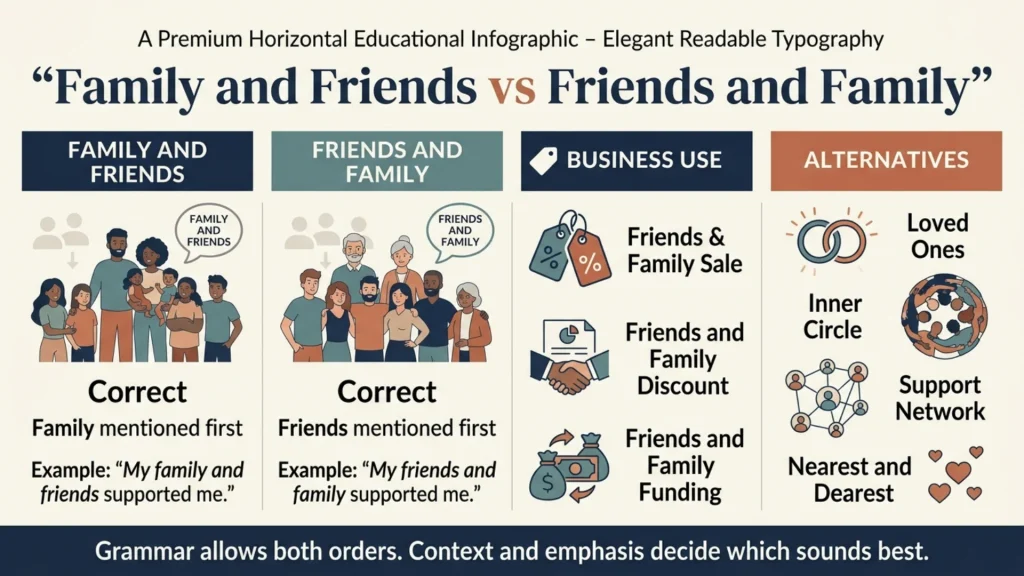
Family and Friends or Friends and Family: Quick Comparison
| Phrase | Correct? | Basic Meaning | Main Difference |
|---|---|---|---|
| Family and friends | Yes | Relatives and friends together | Mentions family first |
| Friends and family | Yes | Friends and relatives together | Mentions friends first |
| Family & Friends | Yes | Same meaning | Compact style for headings or designs |
| Friends & Family | Yes | Same meaning | Common in promotions and event names |
The important point is that changing the order normally does not change who belongs to the group.
Is It Family and Friends or Friends and Family?
Both are correct.
The word and coordinates two noun phrases:
- family
- friends
English grammar does not contain a rule saying that one of these nouns must appear first.
These sentences are both standard:
- My family and friends supported me.
- My friends and family supported me.
They communicate essentially the same message.
Word order can, however, affect what the reader notices first.
Do You Say Friends and Family or Family and Friends?
You can say either one.
A useful rule is to put first whichever group fits the context best.
Use Family and Friends When
“Family and friends” works naturally when:
- the event is centered on family
- relatives are being discussed first
- you are writing a traditional greeting
- you simply prefer the rhythm of the phrase
- family has already been mentioned in the surrounding text
Examples:
- Family and friends gathered for the wedding.
- We are grateful to our family and friends.
- Her family and friends supported her throughout the year.
Use Friends and Family When
“Friends and family” works naturally when:
- friends are the immediate focus
- you are writing casually
- the phrase is being used in marketing
- you are referring to a friends-and-family promotion
- you want to acknowledge a wider personal network
Examples:
- I want to thank my friends and family.
- She celebrated with friends and family.
- The store announced a Friends & Family Weekend.
Neither set of examples creates a grammar rule. They simply show how context can guide word order.
Does the Order Change the Meaning?
Usually, no.
Compare:
My family and friends came to the ceremony.
and:
My friends and family came to the ceremony.
Both sentences say that relatives and friends attended.
The first sentence puts family in the reader’s attention first. The second puts friends first.
That is a difference in emphasis, not a major difference in meaning.
Why Does One Order Sometimes Sound More Natural?
Repeated word combinations can become familiar through use.
English has many pairs that speakers are accustomed to hearing in a particular order, such as:
- salt and pepper
- black and white
- law and order
- ladies and gentlemen
With family and friends and friends and family, however, both orders remain normal enough that you do not need to treat either version as incorrect.
Context and sentence rhythm matter more than trying to invent a rigid grammar rule.
Family and Friends Meaning
Family and friends means your relatives and the people you have personal friendships with, considered together.
For example:
The event was attended by family and friends.
The phrase does not tell us exactly which relatives or friends attended. Context provides that information.
“Family” may include immediate or extended relatives, while “friends” can range from close friends to a broader social circle.
Friends and Family Meaning
Friends and family carries essentially the same meaning.
For example:
She shared the news with friends and family.
The speaker is referring collectively to friends and relatives.
Placing friends first does not automatically mean the speaker values friends more than family. It may simply fit the sentence better.
Friends and Family Meaning in Business
In business, friends and family can have several specific meanings.
Friends and Family Discounts
A friends and family discount is a special promotional price or offer intended for people connected to employees, customers, members, or another defined group.
Businesses may also use:
- Friends & Family Sale
- Friends & Family Weekend
- Friends & Family Discount
- Friends & Family Offer
In this context, the order friends and family has become a recognizable marketing expression.
Friends and Family Funding
In startup finance, friends and family can refer to early investors from a founder’s personal network.
The U.S. Securities and Exchange Commission discusses friends and family as one source of early-stage investment for small businesses and startups in its guidance on early-stage investors.
A business may therefore talk about:
- friends and family investors
- a friends and family round
- friends and family funding
- friends and family capital
Here, friends and family functions as a familiar business label rather than just a casual ordering of two nouns.
Is “Family and Friends” Wrong in Business?
No.
A business can still write:
We appreciate the support of our family and friends.
That is completely natural.
The distinction appears when a company is referring to an established promotional or fundraising phrase.
For example:
- Friends & Family Sale
- Friends and Family Round
- Friends and Family Discount
If that is the official name of an event, campaign, or investment round, keep the established order.
Family & Friends or Family and Friends?
Both forms can be correct, but their style differs.
Use “And” in Normal Sentences
In ordinary prose, write:
We invited our family and friends.
This is cleaner than inserting an ampersand into a normal sentence.
Use “&” in Short Titles and Designs
The ampersand works well in:
- headings
- event names
- invitations
- signs
- promotional graphics
- brand-style titles
Examples:
- Family & Friends Dinner
- Friends & Family Weekend
- Family & Friends Celebration
The ampersand changes the typography, not the underlying meaning.
Family and Friends on Invitations
Both word orders can work perfectly well on an invitation.
Traditional Wording
Please join our family and friends in celebrating this special day.
Neutral Wording
We look forward to celebrating with friends and family.
Formal Greeting
Dear Family and Friends,
Alternative Greeting
Dear Friends and Family,
Neither greeting contains a grammar error.
Choose the one that better matches your audience and tone.
Dear Family and Friends or Dear Friends and Family?
Both are correct salutations.
Dear Family and Friends may feel appropriate when relatives are the central group.
Dear Friends and Family may work better if the message is being sent to a broad social circle or if friends are intentionally mentioned first.
Do not assume that one version is automatically more respectful.
Friends Like Family or Family-Like Friends?
These phrases describe something slightly different from simply saying friends and family.
Friends Like Family
Friends like family means friends who feel as close or important as family.
For example:
Over the years, they became friends who felt like family.
That construction is usually more natural than forcing “friends like family” into every sentence.
Family-Like Friends
Family-like friends describes friends whose relationship resembles a family relationship.
Because family-like acts as a compound adjective before the noun, the hyphen improves clarity.
Example:
They developed a circle of family-like friends.
In most everyday situations, however, friends who are like family sounds more natural.
What Is a Word for Family and Friends Together?
There is no single universal word that always means exactly “family and friends.”
Several alternatives can work depending on tone.
Loved Ones
Loved ones is one of the best general alternatives.
She spent the holidays with her loved ones.
It can include family, partners, and close friends.
Inner Circle
Inner circle refers to the people closest to or most trusted by someone.
It does not necessarily mean relatives.
Social Circle
A social circle refers primarily to the people someone regularly socializes with.
It can include friends and sometimes relatives, but it is broader and less emotional than “loved ones.”
Support Network
A support network refers to people who provide practical or emotional help.
This may include:
- relatives
- friends
- colleagues
- professionals
- community members
Nearest and Dearest
Nearest and dearest is an informal expression for the people someone cares about most.
It can conveniently cover both family and close friends.
Kith and Kin
Kith and kin is an old-fashioned expression referring broadly to friends, acquaintances, and relatives.
It sounds literary today rather than conversational.
What Is a Group of Friends and Family Called?
Useful options include:
- loved ones
- inner circle
- close circle
- support network
- nearest and dearest
- personal network
- community
- social circle
The best choice depends on what the group actually represents.
For an invitation, loved ones is especially flexible.
For business or professional writing, personal network or support network may fit better.
What Is a Fancy Word for a Group of Friends?
Depending on meaning, you could use:
- circle
- circle of friends
- companions
- associates
- confidants
- cohort
- fellowship
- entourage
These are not interchangeable.
For example, confidants are trusted people with whom you share private information, while associates is much less personal.
What Is Another Word for Family Togetherness?
Useful alternatives include:
- family unity
- family closeness
- family connection
- family solidarity
- family harmony
- family bonding
- family cohesion
- shared family time
Choose the phrase that matches what you mean.
Family unity emphasizes being united.
Family closeness emphasizes emotional connection.
Family bonding usually refers to activities or experiences that strengthen relationships.
What Is a Fancy Word for Family?
Depending on context, alternatives include:
- kin
- relatives
- household
- lineage
- clan
- kindred
These words are not exact substitutes in every sentence.
For example:
- kin means relatives
- lineage emphasizes descent or ancestry
- household means people living together
- clan can refer to an extended family or larger social group
Better Words for Togetherness
Alternatives to togetherness include:
- unity
- closeness
- solidarity
- connection
- fellowship
- companionship
- cohesion
- harmony
- community
For personal relationships, closeness or connection often sounds natural.
For groups or organizations, unity, solidarity, or cohesion may be more appropriate.
Other Ways to Say Family Bonding
Instead of repeating family bonding, you can write:
- strengthening family ties
- spending quality time together
- building family connections
- creating shared memories
- strengthening family relationships
- bringing the family closer
- connecting as a family
- nurturing family closeness
The best option depends on whether you are describing an activity, an emotional result, or a relationship.
Family and Friends in Formal Writing
Both phrases are grammatically acceptable in formal writing.
What matters more is whether the whole sentence is clear and professional.
Examples:
The organization appreciates the contributions of employees, family, and friends.
Family and friends are invited to attend the ceremony.
Participants may share the announcement with friends and family.
Avoid turning word order into a supposed formality rule. The surrounding sentence determines the professional tone much more than whether family or friends appears first.
Family and Friends in Casual Writing
In casual writing, you can choose whichever version sounds better.
Examples:
Having dinner with friends and family tonight.
So grateful for my family and friends.
Can’t wait to see friends and family this weekend.
Sending love to family and friends everywhere.
The order can change naturally from sentence to sentence.
Capitalization of Family and Friends
In ordinary sentences, use lowercase:
We invited our family and friends.
Do not capitalize the words simply because the people are important.
In a heading or title, title capitalization may be appropriate:
Family and Friends Celebration
In a salutation, capitalization is also common:
Dear Family and Friends,
Should You Write “Family & Friends” in a Sentence?
Usually, family and friends looks better in regular prose.
Use the ampersand primarily when design, brevity, or a formal event name calls for it.
Normal Sentence
The party was attended by family and friends.
Event Name
Family & Friends Appreciation Night
The second example uses & as part of a compact title.
Which Phrase Should You Choose?
Use this simple guide:
| Situation | Natural Choice |
|---|---|
| General sentence | Either |
| Family-centered event | Family and friends |
| Friends-centered message | Friends and family |
| Traditional salutation | Either |
| Casual social post | Either |
| Retail promotion | Friends & Family is common |
| Startup funding | Friends and family |
| Formal prose | Use “and,” not “&,” unless part of a title |
| Inclusive alternative | Loved ones |
You do not need to turn a harmless word-order choice into a constitutional crisis.
Common Mistakes to Avoid
Claiming One Order Is Grammatically Wrong
Neither order is inherently incorrect.
Assuming First Means More Important
The first noun can receive more immediate emphasis, but word order alone does not prove someone’s personal priorities.
Using an Ampersand Everywhere
The symbol & is useful in titles and labels, but ordinary sentences usually look cleaner with and.
Treating Business Terms Like Ordinary Word Order
If something is officially called a Friends & Family Sale, keep that name rather than reversing it just because you personally prefer “family and friends.”
Confusing Family and Friends With Friends Like Family
“Family and friends” names two groups.
“Friends like family” describes friends who feel like relatives.
Those are different constructions.
Related Grammar Guides
The same general lesson applies to many English questions: grammatical correctness and conventional usage are not always identical.
For another common agreement question, see People Do or People Does?.
You can also compare Was There or Were There? for another case where sentence structure determines the natural form.
Frequently Asked Questions
Which comes first, family or friends?
Neither has to come first grammatically. Use family and friends or friends and family depending on context, emphasis, rhythm, or an established phrase such as “friends and family discount.”
Is there a word for family and friends?
Loved ones is one of the best general expressions for family members and close friends together. Other options include inner circle, nearest and dearest, support network, and personal network.
What is the meaning of friends and family?
Friends and family refers collectively to a person’s friends and relatives. In business, the phrase can also describe special discounts, promotions, investors, or early startup funding involving a founder’s personal network.
What is a group of friends and family called?
Depending on context, you can call them your loved ones, inner circle, support network, personal network, nearest and dearest, or community.
What is a fancy word for a group of friends?
Possible terms include circle, companions, confidants, fellowship, cohort, or entourage, although each has a slightly different meaning.
What is another word for family togetherness?
Useful alternatives include family unity, family closeness, family connection, family harmony, family cohesion, and family bonding.
What is a fancy word for family?
Depending on the context, you can use kin, kindred, lineage, clan, relatives, or household.
What is a better word for togetherness?
Possible alternatives include unity, closeness, connection, solidarity, fellowship, harmony, and cohesion.
What is another way to say family bonding?
You can say strengthening family ties, spending quality time together, building family connections, creating shared memories, or bringing the family closer.
Is “family and friends” grammatically correct?
Yes. It is a standard coordinated phrase joining the nouns family and friends.
Is “friends and family” grammatically correct?
Yes. Reversing the order does not make the phrase ungrammatical.
Should I write “Dear Family and Friends” or “Dear Friends and Family”?
Both are correct. Choose the one that best suits your audience or the emphasis you want.
What does “friends and family” mean in business?
It can refer to a promotional discount or sale for a personal network, or to early-stage startup investors who are personally connected with a founder.
Final Answer
When choosing between family and friends or friends and family, you do not need to worry about one being grammatically wrong.
Both are correct.
Use family and friends when you naturally want to mention relatives first. Use friends and family when friends deserve first emphasis or when the phrase is part of an established business expression such as a Friends & Family Sale or friends and family funding round.
The basic meaning stays the same. The main difference is word order, emphasis, tone, and context.