My Father and I vs. My Father and Me: Correct Grammar & 55 Examples
Both “my father and I” and “my father and me” can be correct. The right choice depends on what the phrase is doing in the sentence.
Use my father and I when you and your father are the subject, meaning you perform the action:
My father and I went to the store.
Use my father and me when you and your father are the object, meaning something is done to you, or when the phrase follows a preposition:
She invited my father and me.
The gift is for my father and me.
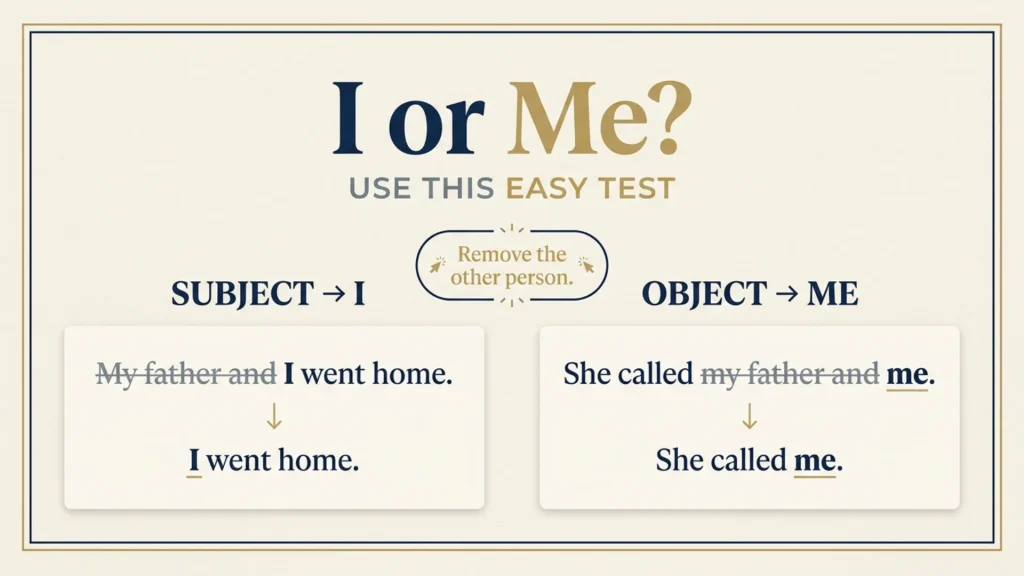
The easiest test is to temporarily remove “my father and.” If I sounds correct by itself, use my father and I. If me sounds correct, use my father and me.
My Father and I vs. My Father and Me: Quick Answer
| Situation | Correct Form | Example |
|---|---|---|
| You and your father perform the action | my father and I | My father and I traveled together. |
| Someone acts on you and your father | my father and me | She called my father and me. |
| After a preposition | my father and me | She spoke with my father and me. |
| Compound subject | my father and I | My father and I are ready. |
| Compound object | my father and me | They invited my father and me. |
Cambridge Grammar explains the underlying rule clearly: I is the subject form, while me is the object form. Object pronouns also normally appear after prepositions. Cambridge Grammar: personal pronouns, I and me
What Is the Difference Between “My Father and I” and “My Father and Me”?
The difference is called pronoun case.
I is a subject pronoun.
Me is an object pronoun.
Compare:
My father and I repaired the fence.
Who repaired the fence?
My father and I.
Now:
The neighbor thanked my father and me.
Who did the neighbor thank?
My father and me.
The people are the same. Their grammatical role changes.
When to Use “My Father and I”
Use my father and I when the phrase functions as the subject of a verb.
That means you and your father are performing the action.
Correct Examples
- My father and I went fishing.
- My father and I watched the game.
- My father and I cooked dinner.
- My father and I visited London.
- My father and I are building a table.
- My father and I have always enjoyed hiking.
- My father and I were talking about you.
- My father and I agree on that point.
- My father and I work well together.
- My father and I will attend the meeting.
In each sentence, my father and I perform the action.
Also check: There Have Been or There Has Been
The Easy “Remove the Other Person” Test
When you are unsure, remove my father and from the sentence.
Consider:
My father and I went shopping.
Remove my father and:
I went shopping.
Correct.
Now try:
My father and me went shopping.
Remove the other person:
Me went shopping.
That does not work in standard English.
Therefore:
My father and I went shopping.
This simple trick solves most dad and me or dad and I questions immediately.
When to Use “My Father and Me”
Use my father and me when the phrase is the object of a verb or preposition.
Object of a Verb
The teacher called my father and me.
The teacher performs the action.
Your father and you receive the action.
Remove my father and:
The teacher called me.
Correct.
Object of a Preposition
She traveled with my father and me.
Remove the other person:
She traveled with me.
Correct.
Therefore, me is required.
Common Prepositions That Usually Require “Me”
Use my father and me after prepositions such as:
- with
- for
- to
- from
- between
- beside
- near
- behind
- about
- without
Examples:
This gift is for my father and me.
Sarah traveled with my father and me.
The manager spoke to my father and me.
Nobody knew about the disagreement between my father and me.
They sat beside my father and me.
“My Father and I” Examples as the Subject
Here are 15 clear examples:
- My father and I went to the market.
- My father and I watched a football match.
- My father and I are planning a trip.
- My father and I built the bookshelf.
- My father and I have the same sense of humor.
- My father and I were invited to dinner.
- My father and I enjoy cooking together.
- My father and I discussed the problem.
- My father and I will arrive tomorrow.
- My father and I attended the ceremony.
- My father and I have already eaten.
- My father and I need more time.
- My father and I used to go fishing every summer.
- My father and I are working on the project.
- My father and I agreed to leave early.
“My Father and Me” Examples as the Object
Here are 15 examples where me is correct:
- She invited my father and me.
- The teacher called my father and me.
- They photographed my father and me.
- The guide showed my father and me around the museum.
- The host welcomed my father and me.
- Someone sent my father and me an invitation.
- The manager thanked my father and me.
- He asked my father and me to wait outside.
- The officer questioned my father and me.
- Everyone congratulated my father and me.
- The news surprised my father and me.
- Sarah drove my father and me home.
- The organizer seated my father and me near the front.
- Nobody recognized my father and me at first.
- The photographer asked my father and me to smile.
Examples After Prepositions
- She went with my father and me.
- The tickets are for my father and me.
- He spoke to my father and me.
- There was an agreement between my father and me.
- The children sat beside my father and me.
- Nobody knew about my father and me.
- The letter came from my father and me.
- She stood behind my father and me.
- They walked toward my father and me.
- He stayed near my father and me.
Dad and I or Dad and Me?
The same rule applies if you use Dad instead of my father.
Subject:
Dad and I went fishing.
Remove Dad:
I went fishing.
Correct.
Object:
Sarah invited Dad and me.
Remove Dad:
Sarah invited me.
Correct.
So:
- Dad and I = usually subject
- Dad and me = usually object
My Dad and Me or My Dad and I?
Neither phrase is automatically correct in every sentence.
Correct:
My dad and I went to the restaurant.
Correct:
The waiter spoke to my dad and me.
Incorrect:
My dad and me went to the restaurant.
Incorrect:
The waiter spoke to my dad and I.
The sentence structure decides which pronoun you need.
My Parents and I or My Parents and Me?
Exactly the same rule applies.
Subject
My parents and I are traveling tomorrow.
Remove my parents and:
I am traveling tomorrow.
So I is correct.
Object
She invited my parents and me.
Remove my parents and:
She invited me.
So me is correct.
For another explanation of subject-verb structure, GrammarRead’s guide to Anyone Has or Anyone Have follows the same principle of identifying a word’s grammatical job before choosing its form.
Is “Me and My Dad” Grammatically Correct?
You will frequently hear:
Me and my dad went shopping.
in informal speech.
People understand it perfectly, and this pattern occurs naturally in casual conversation.
However, in standard edited English, use:
My dad and I went shopping.
because the phrase is the subject.
Compare:
Casual speech:
Me and my dad watched the game.
Standard edited English:
My dad and I watched the game.
But if the phrase is an object:
She photographed my dad and me.
Here, me is correct.
Why Do People Say “Me and My Friend”?
Expressions such as:
Me and my friend went out.
are common in informal spoken English.
This happens because conversational English does not always follow the same case patterns preferred in formal edited writing.
Cambridge Grammar notes that constructions such as “my friends and me went…” or “me and my friends went…” can occur in informal speech, although “my friends and I went…” is considered the more correct standard form.
So the distinction is not that speakers using me and my friend are incomprehensible. The issue is one of standard grammatical style, especially in writing.
Is It Polite to Put the Other Person First?
Traditional style usually places the other person before yourself:
My father and I
rather than:
I and my father
and:
My father and me
rather than:
Me and my father
This is mainly a convention of style and politeness, not the reason for choosing I or me.
Pronoun case still depends on grammar.
My Father and I Are or My Father and I Is?
Use:
My father and I are
because my father and I form a compound plural subject.
Correct:
- My father and I are ready.
- My father and I were there.
- My father and I have finished.
- My father and I do agree.
Incorrect:
My father and I is ready.
For a related subject-verb agreement explanation, see GrammarRead’s People Do or People Does guide.
“Between My Father and I” or “Between My Father and Me”?
Use:
between my father and me
because between is a preposition.
Object pronouns normally follow prepositions.
Correct:
This stays between my father and me.
Incorrect in standard edited English:
This stays between my father and I.
The same pattern applies to:
- between you and me
- between Sarah and me
- between my brother and me
“With My Father and I” or “With My Father and Me”?
Use:
with my father and me
because with is a preposition.
Correct:
She traveled with my father and me.
Incorrect:
She traveled with my father and I.
Remove the other person:
She traveled with me.
Nobody would normally say:
She traveled with I.
The deletion test makes the answer rather mercilessly obvious.
“For My Father and I” or “For My Father and Me”?
Use:
for my father and me
Correct:
These seats are for my father and me.
Remove the other person:
These seats are for me.
Therefore, me is correct.
“To My Father and I” or “To My Father and Me”?
Use:
to my father and me
Example:
She explained the rules to my father and me.
Without your father:
She explained the rules to me.
Correct.
“My Father and I Were” or “My Father and Me Were”?
If the phrase is the subject, use:
My father and I were…
Example:
My father and I were waiting outside.
Not:
My father and me were waiting outside.
For another guide involving singular and plural verb choices, GrammarRead’s Was There or Were There article covers related agreement rules.
My Father and I in Questions
Turning the sentence into a question does not change the underlying subject/object rule.
Statement:
My father and I made the decision.
Question:
Did my father and I make the decision?
The phrase remains the subject.
But:
The teacher invited my father and me.
becomes:
Did the teacher invite my father and me?
The teacher is still the subject, and my father and me remain the objects.
Short Answers
Suppose someone asks:
Who went to the store?
You could answer:
My father and I.
The implied full sentence is:
My father and I went to the store.
Now:
Who did Sarah invite?
Answer:
My father and me.
The implied sentence is:
Sarah invited my father and me.
The missing words still determine the pronoun case.
What About “It Was My Father and I” vs. “It Was My Father and Me”?
This construction is more complicated than the basic subject/object rule.
Traditional formal grammar sometimes favors:
It was my father and I.
However, modern everyday English commonly uses object pronouns after forms of be:
It was my father and me.
Cambridge notes that object pronouns are regularly used as complements of be, such as:
That’s him.
and:
It’s me.
So instead of turning a simple sentence into a grammar obstacle course, rewrite when possible:
My father and I fixed the car.
This is clearer than debating:
It was my father and I who fixed the car.
versus:
It was my father and me who fixed the car.
15 More Correct Examples
- My father and I drove to the airport.
- My father and I have known him for years.
- My father and I were laughing.
- My father and I made dinner.
- My father and I will handle it.
- Sarah met my father and me yesterday.
- The invitation included my father and me.
- They reserved a table for my father and me.
- Nobody spoke to my father and me.
- He shared the news with my father and me.
- My dad and I cleaned the garage.
- Emma thanked my dad and me.
- My parents and I attended the wedding.
- The photographer took a picture of my parents and me.
- Between my father and me, the decision was easy.
Common Mistakes
Incorrect: My Father and Me Went
❌ My father and me went home.
✅ My father and I went home.
Incorrect: She Invited My Father and I
❌ She invited my father and I.
✅ She invited my father and me.
Incorrect: Between My Father and I
❌ Between my father and I, this is difficult.
✅ Between my father and me, this is difficult.
Incorrect: For My Dad and I
❌ These tickets are for my dad and I.
✅ These tickets are for my dad and me.
Informal: Me and My Dad Went
Informal:
Me and my dad went out.
Preferred in standard writing:
My dad and I went out.
The Fastest Rule to Remember
Remove the other person.
Example One
My father and ___ went home.
Test:
I went home.
So:
My father and I went home.
Example Two
Sarah called my father and ___.
Test:
Sarah called me.
So:
Sarah called my father and me.
Example Three
The gift is for my father and ___.
Test:
The gift is for me.
So:
The gift is for my father and me.
This test works for:
- my mother and I/me
- my wife and I/me
- my husband and I/me
- Sally and I/me
- my parents and I/me
- my friend and I/me
- my brother and I/me
Frequently Asked Questions
Is it correct to say dad and me or dad and I?
Both can be correct.
Use Dad and I as the subject:
Dad and I went home.
Use Dad and me as the object:
She called Dad and me.
Do you say my wife and I or my wife and me?
Use my wife and I when the phrase is the subject:
My wife and I are traveling.
Use my wife and me when it is the object:
They invited my wife and me.
Which is correct: “my parents and I” or “my parents and me”?
Both are correct depending on the sentence.
My parents and I live nearby.
She visited my parents and me.
Is “me and my dad” grammatically correct?
It is common in informal speech, but in standard edited English use my dad and I when the phrase is the subject:
My dad and I went shopping.
If the phrase is the object, use:
She called my dad and me.
Is it grammatically correct to say “my mom and I”?
Yes, when my mom and I function as the subject:
My mom and I baked a cake.
When the phrase is an object, use:
The teacher spoke to my mom and me.
What is the rule for using “I” or “me” in a sentence?
Use I as a subject and me as an object.
I called Sarah.
Sarah called me.
The same rule continues to apply when another person is added.
Which is correct, Sally and I or Sally and me?
Use:
Sally and I went home.
But:
The teacher called Sally and me.
What is the difference between “I” and “me”?
I is a subject pronoun. It normally performs the action.
Me is an object pronoun. It normally receives the action or follows a preposition.
Why do people say “me and my friend” instead of “my friend and I”?
Because me and my friend is common in informal spoken English. Formal and edited English generally prefers my friend and I when the phrase is the subject.
That does not mean my friend and me is always wrong. It is correct when the phrase is an object:
She invited my friend and me.
Final Answer
The difference between my father and I vs. my father and me depends entirely on grammatical role.
Use:
My father and I
when you and your father perform the action.
Use:
My father and me
when you receive the action or the phrase follows a preposition.
The easiest test is to remove my father and:
I went home.
She called me.
The gift is for me.
If I works alone, use my father and I.
If me works alone, use my father and me.
That one test handles nearly every everyday case without requiring you to stare at the sentence until the pronouns begin looking personally hostile.