Wish You vs Wishing You: Meaning, Difference & Correct Usage
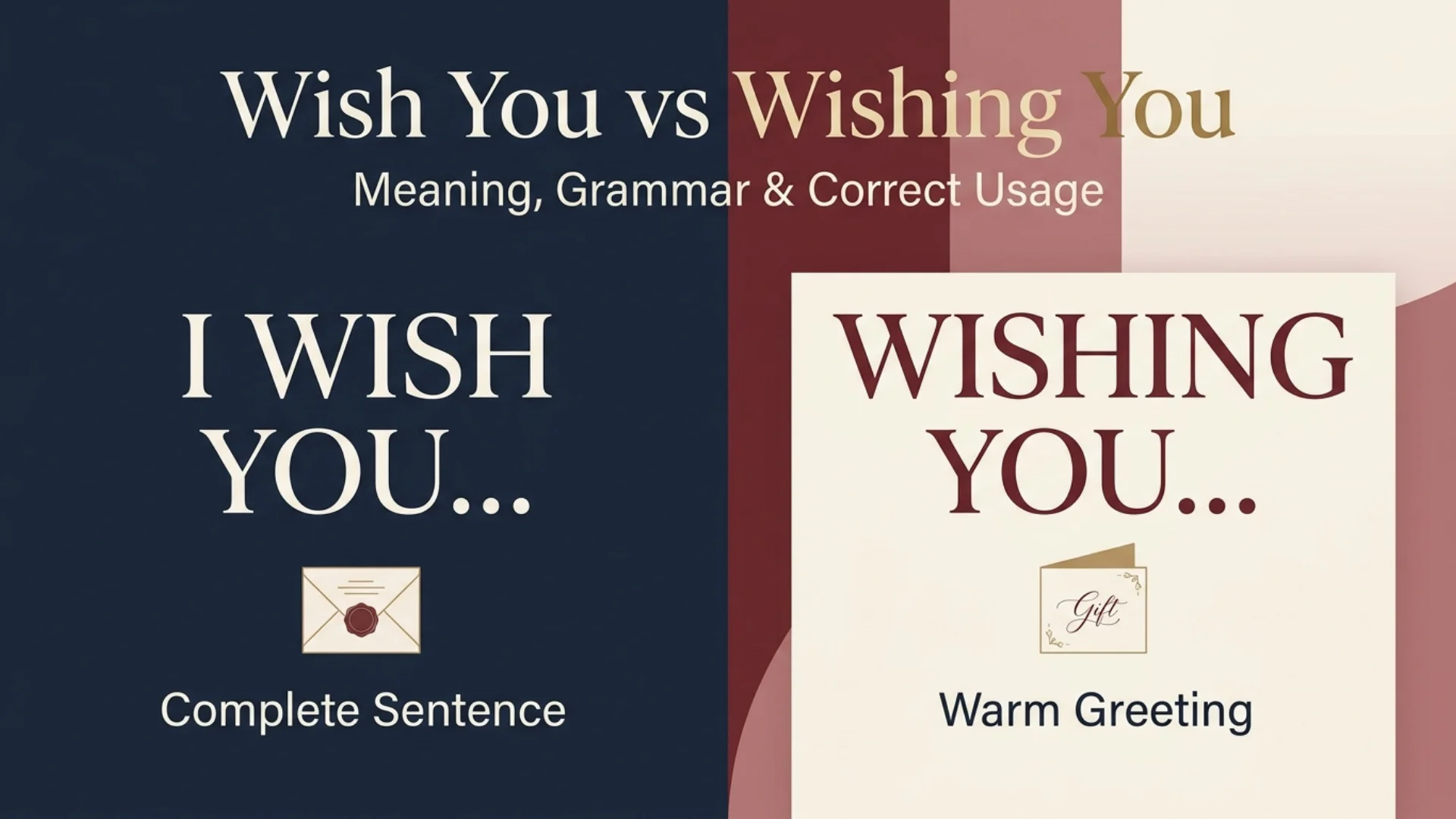
Quick Answer: Both “I wish you…” and “Wishing you…” are correct, but they are used differently.
“I wish you…” is a complete sentence with a stated subject:
I wish you all the best.
“Wishing you…” is a shortened greeting or message in which the subject is understood:
Wishing you all the best.
For formal or complete sentences, “I wish you…” is usually the safest choice. For greeting cards, birthday messages, email closings, congratulations, and friendly notes, “Wishing you…” sounds natural and warm.
The form “Wish you…” without I is common in casual conversation and texting, but in careful standard writing, use either “I wish you…” or “Wishing you…”.
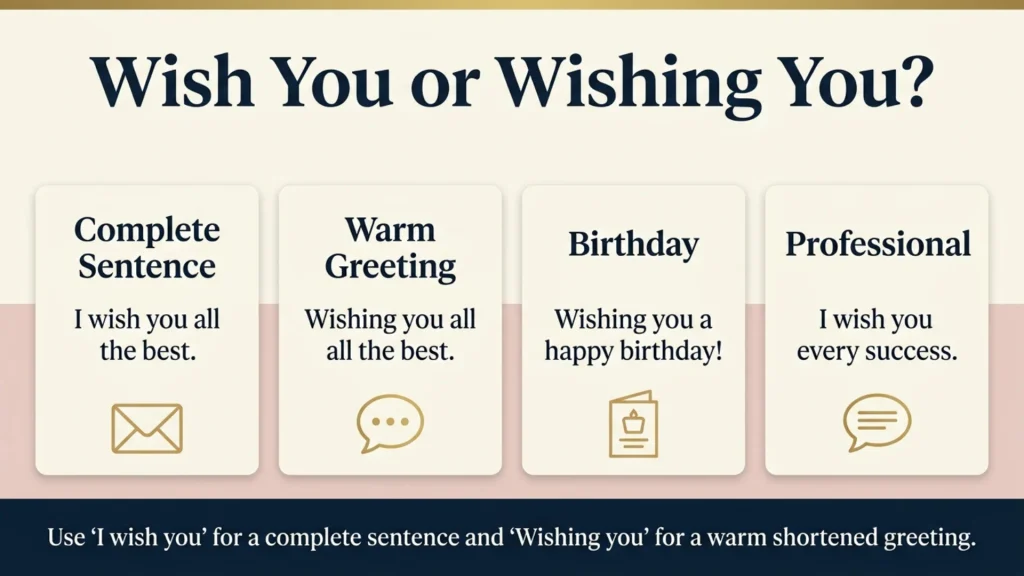
Wish You vs Wishing You at a Glance
| Expression | Correct? | Best Use |
|---|---|---|
| I wish you all the best. | Yes | Complete, direct sentence |
| Wishing you all the best. | Yes | Greeting, card, email closing |
| Wish you all the best. | Informal | Casual speech or texting |
| We wish you success. | Yes | Formal or professional |
| Wishing you success. | Yes | Warm, concise greeting |
| She wishes you well. | Yes | Third-person sentence |
| I wishing you well. | No | Incorrect verb structure |
| I wish you the same. | Yes | Direct response |
| Wishing you the same. | Yes | Warm, shortened response |
The difference is mainly about sentence structure and tone, not about one phrase being universally right and the other wrong.
What Does “Wish You” Mean?
Wish you is built from the verb wish followed by the person receiving the wish.
In a complete sentence, English normally includes a subject:
I wish you happiness.
Here:
I = subject
wish = verb
you = indirect object
happiness = what is being wished
Other examples:
- I wish you success.
- We wish you good health.
- They wish you a safe journey.
- She wishes you a happy birthday.
- I wish you all the best.
Cambridge Grammar explains that wish can take an indirect object plus a direct object when expressing goodwill, as in wishing someone success, luck, or a happy life. You can see the Cambridge Grammar guide to “wish”.
What Does “Wishing You” Mean?
Wishing is the -ing form or present participle of wish.
In greetings, “Wishing you…” works as a shortened expression where the full subject and verb are understood from context.
For example:
Wishing you a wonderful birthday.
The implied meaning is roughly:
I am wishing you a wonderful birthday.
But native English speakers normally prefer the shorter form in cards and greetings.
Other examples:
- Wishing you every success.
- Wishing you good health.
- Wishing you a safe journey.
- Wishing you happiness always.
- Wishing you a wonderful weekend.
- Wishing you all the best.
This form often sounds warm, personal, and greeting-like.
The Main Difference Between Wish You and Wishing You
The clearest difference is grammatical structure.
I Wish You
This is a complete finite clause.
I wish you success.
It has a subject and a main verb.
Wishing You
This is commonly used as a shortened or elliptical greeting.
Wishing you success.
The reader understands who is doing the wishing.
So:
I wish you all the best.
sounds direct and complete.
Wishing you all the best.
sounds slightly softer and more like a card, note, caption, or closing message.
Neither is inherently better.
The context decides which sounds more natural.
Is “Wish You” Correct Without “I”?
You will often see:
Wish you all the best.
Wish you a happy birthday.
Wish you good luck.
These are understandable and common in informal communication, especially in:
- text messages
- chats
- social media comments
- casual speech
- short personal notes
However, careful standard writing usually prefers:
I wish you all the best.
or:
Wishing you all the best.
So if you are writing a professional email, formal card, application, speech, or polished article, do not rely on the shortened “Wish you…” construction.
Wish You or Wishing You: Which Is More Formal?
“I wish you…” generally sounds more complete and structured.
Example:
I wish you every success in your new position.
That works naturally in:
- professional letters
- formal emails
- speeches
- official congratulations
- farewell notes
- business communication
“Wishing you…” is also acceptable in professional communication, especially as a closing.
Example:
Wishing you every success in your new role.
It feels slightly warmer and less formal without being unprofessional.
Wish You vs Wishing You in Emails
Both forms work in emails.
Formal Email
I wish you every success with the project.
Warm Professional Email
Wishing you every success with the project.
Friendly Email
Wishing you a great weekend!
Very Casual Message
Wish you the best!
The final version is understandable, but “I wish you the best” or “Wishing you the best” is more polished.
For other wording choices in professional communication, GrammarRead’s guide to Appreciative of vs. Appreciative for covers another phrase where small grammatical differences affect natural usage.
Wishing You All the Best or Wish You All the Best?
Both can be used, but the most polished forms are:
I wish you all the best.
and:
Wishing you all the best.
I Wish You All the Best
This is a complete sentence.
It works especially well in:
- farewell messages
- professional emails
- congratulations
- speeches
- personal conversations
Example:
I wish you all the best in your new career.
Wishing You All the Best
This is a conventional greeting-style expression.
Example:
Wishing you all the best in your new role!
It feels warm and concise.
Wish You All the Best
This shortened form is common informally:
Wish you all the best!
However, for careful written English, adding I or using wishing is usually better.
Wish You the Best or Wishing You the Best?
Both are natural when structured correctly.
I wish you the best.
Wishing you the best.
You can also say:
I wish you all the best.
Wishing you all the best.
Adding all is particularly common in farewell and congratulatory messages.
Wish You the Same or Wishing You the Same?
Both can be correct.
I Wish You the Same
This is a complete sentence.
Example:
“Have a wonderful New Year!”
“Thank you. I wish you the same.”
Wishing You the Same
This is a warm shortened response.
Example:
“Wishing you happiness this year.”
“Thank you! Wishing you the same.”
In everyday conversation, an even simpler response is:
Same to you!
What Does “Wishing You the Same” Mean?
Wishing you the same means:
I hope the same good thing happens to you.
Example:
Person A:
“Wishing you a wonderful holiday!”
Person B:
“Thank you. Wishing you the same!”
The second person is returning the good wish.
Is “Wish You the Same” Correct?
In informal conversation, yes:
Wish you the same!
But the grammatically fuller version is:
I wish you the same.
You could also use:
Same to you.
Likewise.
Wishing you the same.
The best choice depends on how formal or warm you want to sound.
Happy Birthday: Wish You or Wishing You?
For birthday messages, several forms work naturally.
Correct
I wish you a happy birthday.
Correct and Warm
Wishing you a happy birthday!
Very Natural
Wishing you a very happy birthday!
Simple and Most Common
Happy birthday!
A common error is:
I wishing you a happy birthday. ❌
Use:
I wish you a happy birthday.
or:
I am wishing you a happy birthday.
although the latter usually sounds unnecessarily wordy.
“Wish You Happy Birthday” or “Wish You a Happy Birthday”?
In polished standard English, use:
I wish you a happy birthday.
The article a fits naturally because birthday is a singular countable noun in this structure.
Also natural:
Wishing you a happy birthday.
And even more idiomatic:
Wishing you a very happy birthday!
In casual communication, you may encounter:
Wish you happy birthday
but it sounds less natural than the alternatives above.
Wishing You a Happy Birthday vs Happy Birthday
Both are correct.
Happy birthday! is shorter and more direct.
Wishing you a happy birthday! sounds warmer and slightly more elaborate.
For example:
Happy birthday, Sarah!
or:
Wishing you a very happy birthday, Sarah!
There is no grammatical requirement to make birthday greetings longer. Humans occasionally survive a two-word message.
Wishing You a Good Day or Wish You a Good Day?
The most natural forms are:
I wish you a good day.
or:
Wishing you a good day.
However, in ordinary conversation, English speakers are even more likely to say:
Have a good day.
The have construction often sounds more natural for everyday greetings.
Wish You Good Luck or Wishing You Good Luck?
Use either:
I wish you good luck.
or:
Wishing you good luck.
Also extremely common:
Good luck!
Cambridge specifically gives “Wish me luck!” as a natural imperative expression.
That structure is different because the speaker is asking another person to offer good wishes.
“I Wish You” Sentences
Here are natural examples:
- I wish you happiness.
- I wish you success.
- I wish you good health.
- I wish you a safe journey.
- I wish you the best.
- I wish you all the best.
- I wish you a wonderful birthday.
- I wish you every success in your new job.
- I wish you peace and happiness.
- I wish you a speedy recovery.
Each sentence has:
subject + wish + you + the thing being wished
“Wishing You” Sentence Examples
Common examples include:
- Wishing you happiness always.
- Wishing you every success.
- Wishing you a wonderful birthday.
- Wishing you good health.
- Wishing you a speedy recovery.
- Wishing you a safe journey.
- Wishing you a beautiful day.
- Wishing you a peaceful holiday season.
- Wishing you all the best.
- Wishing you success in your new role.
These are especially natural in cards, messages, captions, and email closings.
Wishing You Meaning in Simple English
Wishing you means:
expressing a hope or good desire for you.
For example:
Wishing you success
means:
I hope you have success.
Wishing you happiness
means:
I hope you experience happiness.
It is generally positive and supportive.
What Does “Wish You” Mean in Hindi?
The exact Hindi translation depends on what follows wish you.
For example:
I wish you success
roughly expresses:
मैं आपके लिए सफलता की कामना करता/करती हूँ।
The broader idea is:
to express a good desire or hope for someone.
Because English wish has several grammar patterns, translating only the isolated words “wish you” can lose important context.
What Does “Wishing You” Mean in Hindi?
Depending on the complete phrase, wishing you conveys the idea of:
आपके लिए … की कामना करते हुए
or more naturally in a complete message:
आपको … की शुभकामनाएँ
For example:
Wishing you all the best
can naturally be understood as:
आपको ढेरों शुभकामनाएँ।
The best translation depends on the full sentence rather than the two words alone.
“Wish You” Artinya
For Indonesian learners, wish you generally expresses:
mendoakan / berharap sesuatu yang baik untukmu
depending on context.
Example:
I wish you success.
Meaning:
Saya berharap kamu sukses / semoga kamu sukses.
Again, the exact translation changes with the full phrase.
“Wishing You” Artinya
Wishing you in a greeting generally carries the idea of:
mendoakanmu
or:
semoga kamu…
Example:
Wishing you happiness.
roughly means:
Semoga kamu bahagia.
The English phrase functions as a warm expression of goodwill.
“As You Wish” Meaning
As you wish is a different construction.
It means:
as you want
or:
according to your preference
Example:
“Can we leave early?”
“As you wish.”
It does not mean the same thing as:
I wish you happiness.
The word wish is doing a different grammatical job.
Wishes You vs Wish You
Wishes is the third-person singular present form.
Use it after:
- he
- she
- it
- one singular person or organization
Examples:
She wishes you well.
John wishes you a happy birthday.
The company wishes you every success.
Use wish after:
- I
- we
- you
- they
Examples:
I wish you well.
We wish you success.
They wish you good luck.
If subject-verb agreement is the confusing part, GrammarRead’s People Do or People Does? guide explains the same broader agreement principle.
Wish vs Hope
Wish and hope overlap, but they are not always interchangeable.
Good Wishes to a Person
Use wish + person + noun phrase:
I wish you success.
I wish you good luck.
Desired Future Event
English frequently prefers hope:
I hope you pass the exam.
I hope you have a wonderful trip.
Cambridge specifically notes that hope, rather than wish, is normally used when we want a future event to happen.
So:
I hope the weather is good tomorrow. ✅
Not normally:
I wish the weather is good tomorrow. ❌
But:
I wish you good weather for your trip. ✅
Different structure, different rule.
Wish + Past Form
Another meaning of wish expresses a situation that is different from reality.
Example:
I wish I had more time.
This means:
I do not have enough time, but I would like the situation to be different.
Other examples:
- I wish I knew the answer.
- I wish I lived closer.
- I wish she were here.
- I wish we had more money.
This use is different from:
I wish you success.
In the first pattern, wish expresses an unreal or desired situation.
In the second, it expresses goodwill toward another person.
Wish + Past Perfect
To express regret about the past, use:
wish + had + past participle
Examples:
I wish I had studied harder.
I wish I hadn’t said that.
She wishes she had arrived earlier.
This is another reason simply translating wish as one fixed English meaning can be misleading.
Wish + Would
Wish + would can express annoyance or a desire for someone’s behavior to change.
Example:
I wish you would stop shouting.
Another:
I wish it would stop raining.
This construction has little to do with a greeting such as:
Wishing you a lovely day.
Same verb, different grammar.
Wishing vs Wishing You
Wishing by itself is simply the -ing form of wish.
Example:
Wishing won’t make it happen.
But:
Wishing you success
directs the good wish toward you.
So adding you changes the phrase from a general action into a greeting or expression directed toward another person.
Wishing U vs Wishing You
Wishing u is texting shorthand.
Standard spelling:
Wishing you
Informal text:
Wishing u all the best!
For professional, academic, or polished writing, spell out:
you
Text abbreviations are useful when typing three letters apparently constitutes an unbearable physical burden, but they do not become standard spelling because phones exist.
Which Sounds Warmer: Wish You or Wishing You?
In many greetings, wishing you sounds slightly warmer and softer.
Compare:
I wish you success in your new role.
Direct and professional.
Wishing you every success in your new role!
Warmer and more greeting-like.
The difference is subtle rather than absolute.
Punctuation and surrounding vocabulary can change the tone significantly.
Which Is Better for a Professional Email?
Both can work.
More Formal
I wish you every success in your new position.
Warm but Professional
Wishing you every success in your new position.
Less Polished
Wish you success in your new position.
The final version is understandable, but the missing subject makes it feel more casual.
For another distinction involving appropriate professional wording, see Informational vs. Informative.
Which Is Better for a Greeting Card?
Wishing you… is especially natural.
Examples:
Wishing you a wonderful birthday!
Wishing you a lifetime of happiness.
Wishing you peace and joy this Christmas.
Wishing you every happiness in your new home.
Greeting cards commonly use sentence fragments and shortened expressions because the message format supplies the missing context.
Which Is Better for a Farewell Message?
Both.
Direct
I wish you all the best for the future.
Warm
Wishing you all the best for the future.
More Personal
Wishing you happiness and success in everything ahead.
None is universally better.
Choose the tone that suits your relationship with the recipient.
Which Is Better for Congratulations?
You can write:
I wish you continued success.
or:
Wishing you continued success.
But congratulations often sound even more natural when stated directly:
Congratulations on your promotion! Wishing you every success in your new role.
This avoids forcing wish into every sentence merely because the message contains good wishes.
Common Mistakes With Wish You and Wishing You
Mistake 1: “I Wishing You”
Incorrect:
I wishing you all the best.
Correct:
I wish you all the best.
or:
I am wishing you all the best.
The first is usually more natural.
Mistake 2: Treating “Wishing You” as Wrong
Wishing you a happy birthday is perfectly natural as a conventional greeting even though it is not structured like a full finite sentence.
Mistake 3: Assuming “Wish You” Never Needs a Subject
In polished standard prose, write:
I wish you success.
rather than simply:
Wish you success.
Mistake 4: Using Wish Where Hope Is Better
Less natural:
I wish you will pass the exam.
Natural:
I hope you will pass the exam.
or:
I wish you success in the exam.
Mistake 5: Saying “Wishes You” After I
Incorrect:
I wishes you success.
Correct:
I wish you success.
But:
She wishes you success.
is correct.
Better Alternatives to “Wishing You”
The best alternative depends on what you want to express.
For Success
- I hope everything goes well.
- Best of luck.
- All the best.
- Here’s to your success.
- I hope you succeed.
For Birthdays
- Happy birthday!
- Have a wonderful birthday.
- Hope you have an amazing day.
- Many happy returns.
For Recovery
- Get well soon.
- Hope you feel better soon.
- Sending you my best.
- Thinking of you.
For Farewells
- All the best for the future.
- Best of luck in your next chapter.
- Take care.
- I hope everything goes well.
This is also where understanding response wording can matter. GrammarRead’s guide to Respond vs. Response covers the difference between the verb and noun forms often used in messages and emails.
What’s Another Way to Say “Wish You Well”?
Natural alternatives include:
- I hope you’re doing well.
- All the best.
- Best wishes.
- Take care.
- I hope everything goes well for you.
- I hope things work out.
- Sending my best.
- Best of luck.
The exact alternative should match the situation.
What Is Another Word for “Wishing”?
Depending on the sentence, alternatives can include:
- hoping
- desiring
- wanting
- longing
- expressing
- sending
- offering
But they are not automatically interchangeable.
For example:
Wishing you good luck
can become:
Sending you good luck and best wishes
but:
Wanting you good luck
would sound unnatural.
What Is a Stronger Word Than “Wish”?
There is no single stronger synonym that works everywhere.
Depending on meaning, you might use:
- hope
- desire
- long for
- pray for
- aspire to
- yearn for
But these words have different tones.
Compare:
I wish you success.
I hope you succeed.
I pray for your success.
The final sentence introduces a religious or deeply earnest meaning that the original does not necessarily contain.
How Do I Say “I Wish” in Another Way?
Depending on context:
I wish I had more time.
could become:
If only I had more time.
But:
I wish you success.
could become:
I hope you succeed.
or:
Best of luck.
There is no universal replacement because wish has several grammatical meanings.
How to Wish Someone in a Unique Way
Instead of relying on a generic phrase, make the message specific.
Rather than:
Wishing you all the best.
Try:
Wishing you a new chapter filled with exciting opportunities and people who appreciate everything you bring to the table.
For a birthday:
Wishing you a year filled with good health, memorable adventures, and plenty of reasons to celebrate.
For a new job:
Wishing you confidence on day one, great people around you, and every success in the role ahead.
Specificity usually sounds more thoughtful than hunting for an unnecessarily exotic synonym for wish.
Easy Rule to Remember
Use this simple distinction:
Complete Sentence
I wish you…
Example:
I wish you every success.
Greeting or Closing
Wishing you…
Example:
Wishing you every success.
Casual Short Form
Wish you…
Example:
Wish you the best!
Understandable, but less polished.
If you are unsure in professional writing, choose:
I wish you…
If you are writing a card or warm closing, choose:
Wishing you…
Frequently Asked Questions
Is it correct to say “wish you the same” or “wishing you the same”?
Both are understandable, but the polished forms are “I wish you the same” and “Wishing you the same.” In casual conversation, “Same to you” is also very natural.
Which is correct: “wish you the best” or “wishing you the best”?
Both can be correct depending on structure. Use “I wish you the best” as a complete sentence or “Wishing you the best” as a greeting-style expression. Bare “Wish you the best” is common but more informal.
Is it “wish you a happy birthday” or “wishing you a happy birthday”?
For polished English, use “I wish you a happy birthday” or “Wishing you a happy birthday.” Both are correct. The second is especially common in greeting cards and messages.
What can I say instead of “wishing you”?
Depending on context, try “I hope you have,” “Best wishes for,” “All the best,” “Good luck with,” “Sending you my best,” or simply state the greeting directly.
What’s another way to say “wish you well”?
You can say “All the best,” “Take care,” “I hope everything goes well,” “Sending my best,” or “Best of luck.”
What is another word for “wishing”?
Depending on the meaning, possible alternatives include hoping, desiring, wanting, longing, or sending. They are not interchangeable in every sentence.
What is a stronger word than “wish”?
Depending on context, hope, desire, long for, yearn for, or pray for may sound stronger, but each carries a different nuance.
How do I say “I wish” in another way?
For unreal situations, “If only…” may work. For positive future outcomes, “I hope…” is often better. For greetings, phrases such as “Best wishes” or “All the best” can replace a full wish sentence.
What does “wishing” mean?
Wishing is the -ing form of wish. It refers to wanting or hoping for something, or expressing goodwill toward someone.
How to wish someone in a unique way?
Make the message specific to the person’s situation. Mention the new job, birthday, journey, achievement, recovery, or next chapter rather than using only a generic “best wishes” phrase.
Is it proper to say “I wish you well”?
Yes. “I wish you well” is completely correct. It means that you hope good things happen to the person.
Is “wishing you” grammatically correct?
Yes. “Wishing you…” is widely used as a shortened greeting or closing, especially in cards, messages, and emails.
Is “I wishing you” correct?
No. Use “I wish you” or, less commonly, “I am wishing you.”
Final Thoughts
The Wish You vs Wishing You difference is primarily about grammar and style.
Use:
I wish you…
when you want a complete, direct sentence:
I wish you every success.
Use:
Wishing you…
when you want a warm, concise greeting or closing:
Wishing you every success.
The shortened form “Wish you…” is common in texting and casual conversation, but polished English generally sounds better with I wish you or wishing you.
Also remember that wish has several other grammatical uses. It can express goodwill, unreal desires, regret, or a desire for behavior to change. That is why understanding the structure matters more than memorizing a single phrase.
For cards and friendly messages, wishing you often feels warmer.
For formal complete sentences, I wish you is the safest choice.